A professional K9 handler and trainer has said that banning electronic training collars (e-collars) would only drive their use underground, and will lead to freedom being removed from dogs and their owners.
Gemma Melton, founder of Modern Canine Owners Association (MCOA), told Gript that the effects of a ban would be “devastating” and that e-collars, used by trained professionals in specific circumstances, can be life-saving.
Ms Melton is a professional dog trainer and working K9 handler, who has worked and trained dogs for over 15 years. She owns the Royal Canine Association Academy in Navan, Co Meath, provides doggy daycare, dog training, dog boarding, dog training and board and train programme for dogs of all breeds. Her family-run business also provides services to restricted breeds, and to dogs with complex needs, such as separation anxiety, aggression, and health issues.
Alongside her business, Ms Melton and her two personal dogs provide security services to businesses, individuals and organisations.
She decided to found MCOA in order to raise awareness regarding the use of e-collars, and to campaign against proposals to ban the collars.
Ms Melton was speaking as the deadline for submissions to a government consultation on a proposed ban on the collars was extended until 16 February.
Banning the use of electric collars for dogs and cats in Ireland is currently under consideration by the Advisory Council for Companion Animal Welfare, which was set up in 2021 to advise the Minister on such matters.
Advocates of a ban include Fine Gael Senator Regina Doherty, who has described the use of e-collars as a “harmful and cruel method” to train dogs.
However, Ms Melton told Gript she has dozens of clients on her books at present whose dogs are going through the e-collar training process. She says that while the e-collar is not a “big part” of her job, as it is only used when necessary, it remains “integral” to being able to keep dogs and families safe.
“I have trained very successfully dogs who had incredibly serious behavioural issues, such as chasing squirrels, or not coming back when called despite going thousands of reps with positive reinforcement,” she said.
“Dogs are going to fulfil their genetic potential as predators – that is a fact – and when it comes to addressing this, e-collars are an incredibly humane and non-damaging way to interrupt that predatory process or stopping a dog from doing something stupid which may put themselves or others in danger.
“To have that taken away would take away a huge amount of dogs’ freedom. It may even take certain dogs away from people,” Ms Melton added.
She said that not all of the dogs she handles need e-collars.
“That is for sure — they don’t’. But as a general rule for a breed which is on the tougher spectrum for dogs, they will have an inherent need for someone to provide more specialist training, and an e-collar can sometimes be part of that.”
The professional also raised the issue of sheep and livestock, saying that the use of e-collars can help to protect livestock if the collar is used in the correct way with appropriate training.
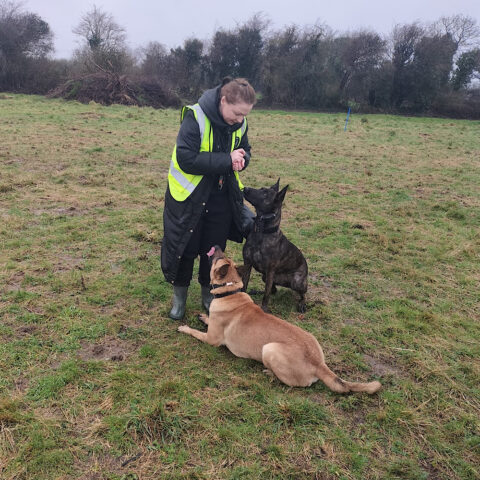
“If the e-collar training is done correctly by someone who knows what they are doing, then the dog will have no idea when the collar is on and when it isn’t.”
“The dog will not actually know that it is the collar delivering a static pulse which gives them the startling reflex when they are around sheep. They have no idea it is happening. That is why it is advisable to have the training done with a professional.”
Ms Melton says she knows a lot of other trainers, who, like herself, will use the e-collar if it is needed. However, she stresses, “It’s not all that I do.”
“All of my work is positive based and play based but sometimes an e-collar needs to be layered in. But no these dogs don’t know that the collar is even there with proper training, not at all. The collar can be there or not.”
‘CRUEL AND HARMFUL?’
Asked about claims that the collar is cruel, due to the delivering of shocks, Ms Melton said this was not the case. While the collar can be “uncomfortable” at the upper levels, she insists that is part of its job, particularly with the livestock worry.
“Electric shock collars are designed to give electric shocks to dogs by way of metal conductors which contact the neck, with up to 6,000 volts emitted for up to 11 seconds at a time,” Senator Regina Doherty has said.
However, Ms Melton insisted she was “baffled” as to where that information came from.
“Senator Doherty quotes something I believe Dogs Trust have said in the past. I would just point out to begin with that people are completely misnaming the e-collar as a shock collar. This isn’t correct, because the e-collar does not emit electric shocks. It is a static pulse.
“There is no live electricity going through the contacts on the e-collar. The Senator talks about how the e-collar emits shocks at 11 seconds — but the battery of the e-collar is only a five volt battery. It is not powerful enough to even power a smoke alarm – there are no 6000 volts in this thing, I don’t know where that is coming from.”
Ms Melton told Gript that shock collars are not the same as e-collars, but that modern e-collars can be differentiated because they no longer use shocks.
“They use static pulses, much like a TENS machine. Take electric shocks – they will burn because they generate heat – but e-colalrs do not. The technology has come a long way.”
She also believes there is an academic conversation to be had regarding the actual type of sensation the dog is feeling.
“There is also no evidence to show that the e-collar is detrimental to dogs. But we do have ample evidence that this is the best, most sophisticated tool we have. Surely it should be celebrated instead of vilified.”
The dog trainer said the button of the e-collar has a 10 second cut-off point for emitting the static pulse to the dog continuously. She adds that the collar “does not generate heat” and describes it as “benign.”
“Yes, it can be uncomfortable at the upper levels but that is part of its job, particularly with the livestock worry. And I don’t believe that is actually a bad thing – I would rather that than have a bullet in one of my dogs because they were shot for killing sheep.”
She asserts that one point she believes “gets lost in the conversation” is that e-collars are a communication tool.
“They are a certain form of a communication tool. The fact that the collar can deliver a correction at a higher level is completely secondary to what it actually is. At the lower level, the collar does not hurt and does not cause discomfort, but the dog can feel it, and it’s a way of communicating with our dogs over incredibly large distances once we teach them what it means.
“Properly trained dogs know to come back when they feel that collar, and it’s instant because they have been trained with this so there is no need to deliver corrections when the training has been done properly.”
She acknowledges that there is an idea that the collars are cruel, causing fear and pain. Yet, she says that when a dog understands the “rules of what is happening and why a correction is happening,” there is “no fear” but the dog simply understands that for their own safety and the safety of others, they cannot do it again.
“I believe there is an ethical way of doing a correction – the dog knows why it happens because the training building blocks have been put in place underneath wearing the e-collar,” the dog trainer told us. “It does not cause fear or confusion for the animal if the animal has gone through the training process to teach them what it means.”
“You cannot teach a dog using pain or fear,” she stresses.
Ms Melton, who set up the Modern Canine Owners Association just before Christmas, has released a number of social media videos addressing the proposed ban.
“I still haven’t gotten through the messages from the first video I released,” she says. She adds that the “biggest thing” she has seen since launching her campaign is the number of people in rural Ireland, who own dogs for protection, who use e-collars.
“For those in rural parts of the country, they have their dogs wear the e-collars when they are out to prevent them from going into the neighbour’s field. These dogs and owners have more freedom because of these collars, and I would stress also that these dogs live really happy lives. I didn’t realise just how many people probably do use e-collars in rural Ireland so they can have their dogs and allow them their freedom.
“The online world of dogs would maybe convince you that nobody uses e-collars – yet i have gotten hundreds of emails from people who do.”
Asked about positive reinforcement as an alternative to using e-collars, Ms Melton said that the issue is “nuanced” and that while she uses positive training, the collar is used for behavioural issues if absolutely necessary.
“The e-collar is not used to train. However, if I have done al the positive training I can do, and the dog is still displaying a problem behaviour, such as not coming back when called – something which can be a life or death situation – then we may layer in a e-collar to the training.”
“The dog could kill someone or get killed, and then there is the livestock issue. If we have gone through all the training and behaviour in the positive route – and we will do this for months without an e-collar – I would introduce an e-collar at the end of that process and I haven’t had it fail yet.”
DRIVING E-COLLAR USE UNDERGROUND?
If an e-collar is added at the end of the training process, you will have a “beautifully trained dog,” she says.
Regarding a legislative change, she believes that banning e-collars would take the collars out of the hands of professionals, and put into the hands of “people who will buy them and use them anyway.”
“A ban would take them out of the hands of people like me – professionals who are trying to help these dogs and families. I will not use them anymore if they do become illegal, and neither will any professional trainer. However, what I believe it will do is drive people underground learning how to use them.”
She believes people will turn to “YouTube and other places,” something she says is not going to work, adding that a ban would take away the concept of the necessary training which must be done before using an e-collar.
“It is the training which makes an e-collar a positive thing to use. However, if they are outlawed, people will not know how to use them, and the training won’t be professional.”
“There is a bad way to use any tool, and there is a bad way to use e-collars,” she adds.
“If you just put an e-collar on a dog, and hit the maximum level when the dog runs into the road, that can be extremely harmful. That can shut down a dog, and will probably terrify it. It can be very damaging. It could also be incredibly painful if done for the first time when the animal has no idea what is going on. That’s not how the e-collar should be used. The dog must go through a proper training process.”
She insists that e-collars should not be banned simply because they can be used in the wrong way, adding that the majority of the time they are used correctly.
I have two different brands of e-collars and one of them has 100 different levels while the other has 127. Most of the levels under 30 are not perceptible to people. It is incredibly precise technology that allows you to tailor it to the dog – what one dog notices another won’t.
“The technology allows you to tailor the settings to the dog. So while one dog may feel what is like a tap on the shoulder, another may not feel anything at all. It is amazing technology and I believe we should embrace it correctly, rather than seeking to ban it.”
The consultation by the Department of Agriculture can be found at the bottom of this page, and states:
“The use of remotely controlled electronic shock collars in dogs and cats has been banned in several European countries on the grounds of animal welfare. The question of whether the use of these devices on dogs and cats ought to be banned in Ireland is under consideration by the Advisory Council for Companion Animal Welfare, which advises the Minister on such matters.”
Stakeholders are invited to make a submission to the consultation by email to animalwelfare@agriculture.gov.