A familiar pattern has manifested itself in recent years, one that sees public opinion and concern land on the one side of an issue, and academic, civic, journalistic and government-adjacent fall on the other side of it. A read through the review of the public consultation submissions for the ‘National Counter Disinformation Strategy’ reveals that this pattern was once again present, to a degree of almost archetypal perfection.
Described by Media Minister Patrick O’Donovan as the “first step” in setting out what a “whole-of-society response” to the problem of disinformation looks like, among the NCDS’s preoccupations are the threats posed by “Foreign Information Manipulation and Interference” (FIMI) to electoral integrity, boosting fact-checking and pre-bunking capacity in the Irish information space, and establishing a ‘Counter Disinformation Oversight Group,’ “to ensure coordination, monitoring and implementation of the Strategy’s commitments and actions”.
With those actions and interests being firmly in the strategy’s – and relevant stakeholders’ – sights, one might reasonably be concerned about any number of things: who decides what constitutes disinformation (or misinformation), whether it’s altogether sensible to increase Government’s direct and indirect presence in the information space (and the regulation of that space), what parallel systems of accountability will be keeping track of the disinformation trackers, etc.
The strategy’s pained efforts to allay those fears are spread throughout the document, with repeated reminders that it’s taking a “rights-based” approach to the matter, an approach laden with more principles than you can shake a stick at. Why they felt they had to emphasise this becomes clear once you have a look at the public consultation submissions review, which shows, as alluded to above, that the public by and large thought the strategy not only unnecessary, but potentially dangerous.
In the roundup of “emerging themes” and under the entry “need for the strategy,” we read:
“While the survey did not pose the question of whether a strategy was required, it was clear from most of the responses from the general public that they did not feel that a strategy was needed. This was also accompanied by a view that the strategy would result in censorship… In contrast to this, the vast majority of responses from organisations supported the principles and the principles based approach to the strategy.”
The remaining themes all, equally, allude to the spirit of scepticism and caution alive and well in the 393 submissions they received from members of the public (roughly 84 percent of the total submissions received).
Another theme that emerged from the submissions was the need to protect freedom of expression, the review noting that a “significant number of responses from the general public expressed concern that the strategy could be a way for the Government to curtail freedom of expression or censor views”. This was coupled with “many” responses that advocated for letting online communities essentially self-regulate, at least as far as the flow of information is concerned.
“They were largely of the view that there should be no regulation or restriction on information, the press or any media outlets,” it says.
Additionally, noteworthy enough to be considered one of the five emergent themes was concern about the trustworthiness of mainstream media, especially RTÉ. Some submissions from the public were “suspicious of ‘mainstream media’ as a proxy for Government orthodoxy and indicated a higher level of trust in non-mainstream media and citizen journalists,” it says, adding that many respondents pointed to a need to facilitate multiple viewpoints, especially in order to enable people make their own decisions on issues.
X, formerly Twitter, the review says, was cited as an exemplary way of finding “alternative views”.
Representing the opposite perspective then, were the organisations that made submissions. The review lists the following as having made them:
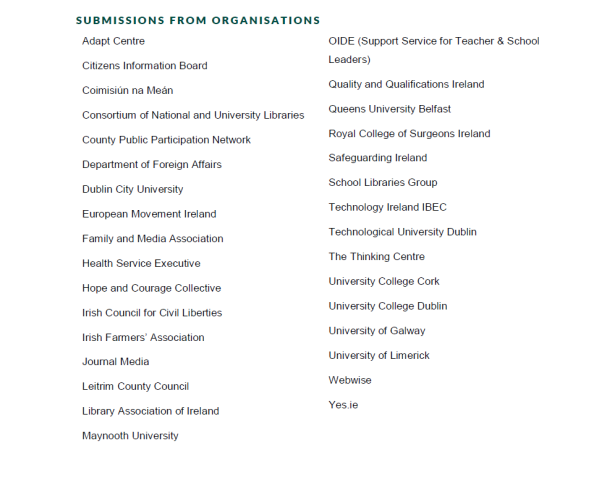
Whereas the public were wary of the strategy, and expressed concern about the potential for censorship, we’re told that “the vast majority of responses from organisations supported the principles and the principles based approach to the strategy”.
An area of consensus was apparently that of “media literacy” and critical thinking, which were skills supported by both members of the public and organisations. Given the apparently divergent priorities and concerns on different topics from those two camps, one wonders whether members of the public had the same understanding of media literacy and critical thinking as the organisations in question.
Because in another point of difference, while the public was mostly of the view that there should be no regulation or restriction on information, the press or any media outlets, “responses from academia and civil society organisations noted the important role of Coimisiún na Meán as an independent regulator under the EU Digital Services Act, and the existing strengthened EU Code of Practice on Disinformation”.
“Alongside this, a significant number of submissions from academics, civil society groups and industry were in favour of regulation and understood the need for effective corporate enforcement, as envisaged by the implementation of Digital Services Act,” it reads.
Those, largely opposed, viewpoints run throughout the different areas the public consultation considered, with the sentiments expressed in the sample quotes derived from submissions made by members of the general public being almost entirely being of a completely different mindset to those quotes drawn from submissions made by organisations or those coming from academia, media or civil society backgrounds.
Despite repeated assurances from the working group that “combatting disinformation” is not about censorship or Government deciding what’s right and wrong, but rather is about “protecting high quality journalism…reducing the availability of harmful online content like disinformation,” I’m not convinced that any of what the public said in their submissions actually registered with the working group behind the strategy on any deep level.
But there was always going to be an imbalance. While there were – to the best of my knowledge – no members of the general public on that working group, there were members from some of the organisations that made submissions to the public consultation, and members of some of those organisations also gave presentations to the working group in the course of its work.
While those with access to the inner circle establishing itself in Ireland’s information space may not currently grok public concerns about the potential de-legitimisation of certain kinds of information, talking points and narratives, they ought to at least understand that from outside that circle, the vista is very different indeed.