A landmark new study has found a sharp rise in specialist psychiatric treatment needs among young people who had undergone medical sex-alteration procedures, rather than an improvement in mental health.
The major register study found that specialist psychiatric treatment was substantially more common among those who had been referred to gender identity services than among matched population controls.
The peer-reviewed study, published in Acta Paediatricia, examined 2,083 young people under the age of 23 who contacted Finland’s gender clinics in the twenty year period between 1996 and 2019.
They were tracked alongside 16,643 matched controls – people from the general population who had not been referred to those services.
The paper by university professors Sami-Matti Ruuska, Katinka Tuisku, Timo Holttinen and Rittakertu Kaltiala was published in Acta Paediatricia in April but has gained significant online in recent weeks:
Among all of the gender-referred young people, specialist psychiatric treatment was recorded in 45.7% before referral – compared with 15% of controls.
At least two years after referral, the rate was 61.7% versus 14.6%. For those referred after 2010, the pre-referral figure was 47.9%, compared with 15.3% in controls.
Among those who underwent medical gender reassignment, recorded psychiatric treatment increased from 9.8% to 60.7% in those undergoing feminising treatment and from 21.6% to 54.5% in those undergoing masculising treatment.
Young people referred after 2010 (following a sharp surge in referrals) exhibited greater psychiatric needs both before and after contact with gender services compared to earlier cohorts.
After accounting for previous psychiatric treatment, year of birth and date of referral, gender-referred young people have approximately 4.7 – 6.1 times the subsequent risk of specialist psychiatric treatment compared with male controls, and 3-3.7 times the risk compared with female controls, depending on the subgroup.
Researchers wrote: “Actually, considerable increases in need for psychiatric treatment were seen among those adolescents who had undergone medical GR, particularly among those seeking change toward female.
“Oestrogen has been found to potentially cause depressive symptoms in both cisgender women and transwomen, which may partly explain the increases in psychiatric needs among those who underwent feminising GR.
“Masculinising hormones may temporarily improve mood, and testosterone-related bodily changes—typically emerging within a few months —could be expected to alleviate GD and subsequently psychiatric treatment needs.
However, psychiatric treatment needs were also markedly increased among those who obtained masculinising GR. Subsequent morbidity burden may also arise from treatments not meeting the expectations placed on them.”
The study operationalised psychiatric morbidity primarily through contact with specialist psychiatric services – meaning the register recorded whether someone had received specialist psychiatric treatment.
The study therefore showed that specialist psychiatric treatment became much more common following referral among those who underwent medical reassignment.
A letter published in Acta Paediatricia subsequently raised concerns about the study’s methodology, however, arguing that the Finnish gender-care pathway itself involves psychiatric assessment.
This, the letter argued, potentially creates what researchers call surveillance / detection bias. However, it is noted that this does not invalidate the study’s findings.
However, autbors have said that the study has several strengths, including a large, nationally representative sample, a three-decade inclusion period that allowed exploring secular trends, the use of matched population controls and a long follow-up period.
Researchers noted the register-based study tracks correlation and treatment utilization rather than establishing direct causation (i.e., whether medical transition worsened mental health or if underlying severe distress persisted despite care).
“Severe psychiatric morbidity is common among gender-referred adolescents and appears to be more prevalent in those referred after the recent surge in referrals. Psychiatric needs do not subside after medical gender reassignment,” the professors behind the study said.
Authors added that the adolescents had markedly higher psychiatric morbidity than controls before and after referral, with treatment needs often persisting and even intensifying after medical interventions— on some, they might even have a negative impact, they said.
On clinical implications, said that the research underscores the need to thoroughly assess and treat mental disorders among those seeking gender reassignment before and after undergoing irreversible treatments:
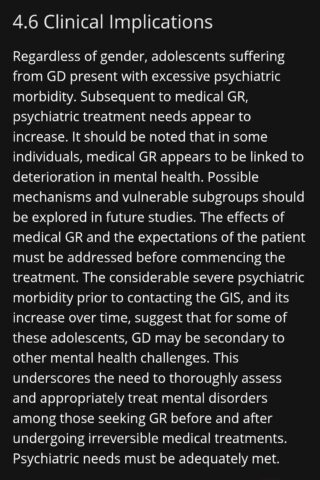
They say that their findings have emphasised the need for thorough psychiatric assessment and ongoing treatment throughout medical gender reassignment.