Dublin City Council is being asked to approve another change of use on Talbot Street, a neighbourhood that has already borne more than any part of the city should.
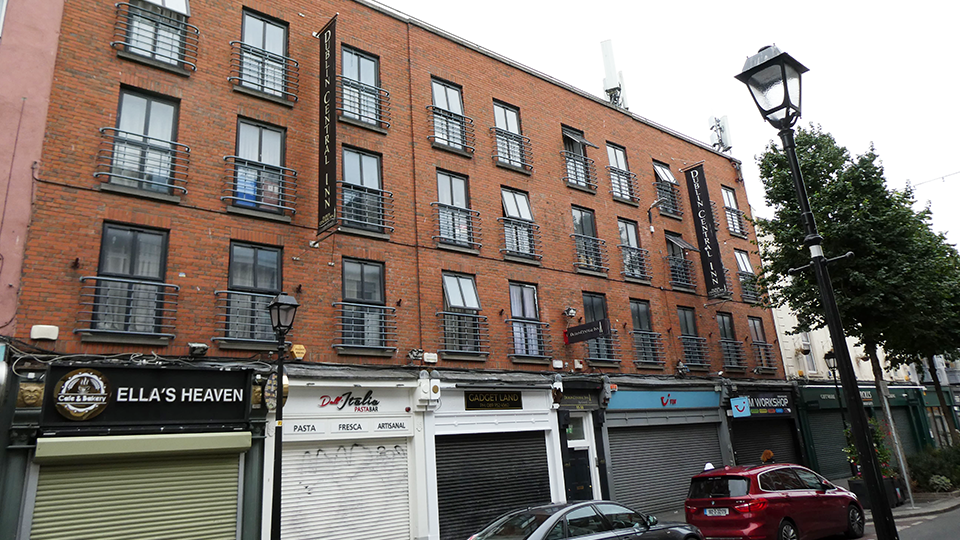
The latest move, filed quietly as Application 0335/26, seeks to reclassify the Dublin Central Inn as accommodation for protected persons under Class 14(h).
On paper, it looks routine. On the ground, it is another test of how far one street can be stretched before something gives.
Talbot Street was once an elegant Georgian link between Connolly Station and O’Connell Street. Years of reactive planning have reduced it to a patchwork of hotel conversions, emergency accommodation and short-term uses, hollowing out the upper floors.
What remains is a street that remembers what it once was – often the saddest state of all.
A recent appeal report on the same building detailed the damage. The historic fabric is eroded, and protected structures have been reduced to fragments.
Façades are patched and repatched after decades of neglect. The public realm never recovered.
The wider district has carried the same burden. Dorset Street, Gardiner Street and the Talbot Street hinterland have become the centre of the city’s homelessness response.
Senior officials have already admitted what locals have known for years: Dublin 1 is “very over‑concentrated” and is carrying far more than its share of emergency accommodation.
The Dublin Region Homeless Executive went further. It said the system had stretched “from the airport all the way down through Dorset Street and Gardiner Street” before anyone realised the scale of the damage.
In 2024, it introduced an over‑concentration check and confirmed that no new emergency contracts were being signed in Dublin 1 because “the damage is done”.
Against that backdrop, this latest application lands awkwardly. Class 14(h) was meant as a narrow relief valve to allow certain premises to be repurposed quickly for international protection needs.
It was never designed to intensify emergency‑type accommodation in districts already overwhelmed.
The exemption applies only where the existing use is lawful and established, and only where the change of use is the sole planning issue.
It does not override broader planning concerns. It does not remove the Council’s responsibility to manage concentration, amenity and the long‑term health of the urban core.
Talbot Street’s recent planning history shows why this matters. Hotel expansions have been refused for overdevelopment, poor amenity and harm to the historic streetscape.
The Council has already acknowledged that further intensification would damage what remains of the area’s architectural dignity and civic function, even though its own decisions helped bring the street to this point.
And as usual, the people who actually live here had no meaningful say in any of it. It is another example of how major decisions land on Dublin 1 first, and democratic consent arrives last, if it arrives at all.
The neighbourhood keeps absorbing the consequences of policies it never agreed to, while the decision‑making stays locked behind doors far from the streets carrying the load.
The Section 5 process only deepens that gap. A Section 5 is a formal request asking the Council to decide whether something is or isn’t development under planning law.
These declarations are not made available to the public in any meaningful way, so decisions that reshape a community can be signed off without the community ever seeing the reasoning.
Talbot Street’s proximity to protected structures, its fragile retail mix and its role as a key pedestrian corridor demand careful stewardship. Too often that has been missing.
The new application, lodged on 12 August, poses a blunt question: can Talbot Street take any more?
Coziq Enterprises Limited is just one operator within a much wider pattern, but its request falls within a district already stretched beyond capacity. The evidence points one way.
The north inner city has become a holding zone for the fallout from national housing failures, with private operators filling gaps left by the State. Long-term residents, vulnerable families and transient populations are now compressed into a narrow urban strip, with little strategic planning.
Whether the Council rules the change exempt or demands full permission, the underlying issue remains.
Dublin cannot keep loading its most fragile neighbourhoods with the most complex social pressures. Over-concentration is not an abstract term. It is lived every day on streets such as Talbot Street.
Every new proposal now has to be judged not only on technical grounds but also on whether it contributes to a sustainable, balanced future for the city.
Talbot Street deserves that level of care, and so does Dublin City Centre.