This we learned from the front page of the Irish Daily Mail in recent days: The newly elected Mayor of Galway, Labour Councillor Helen Ogbu, has deleted her website which contradicted interviews she gave about her life when she arrived in Ireland.
What we also learned from the mainstream media this week is that it seems it is now considered racist to question a politician from an ethnic minority, even if the story about their arrival in Ireland didn’t always make sense.
The Irish Daily Mail sent a reporter to Cllr Ogbu’s door last week after she declined to answer the paper’s questions amid several requests for comment in recent days. She had no comment for the reporter, the newspaper notes, but did a podcast interview with Sile Seoige, which Ms Ogbu has since promoted on Instagram.
Now, Mail journalist Brian Mahon says that the Labour party tried to intimidate him by issuing a “highly personal” attack prior to that story being published earlier this week. Labour’s claim that the Irish Daily Mail’s actions was “intimidatory and unacceptable” were widely carried across outlets, including RTÉ and The Examiner.
Mahon says he believes that it was Labour itself that failed in its duty of care to Helen Ogbu by “consistently repeating the wrong points about her back story.”
“That was their doing, not mine,” Mahon said this morning.
The storm around Cllr Ogbu’s origin tale comes only weeks after Ogbu established her popularity in the Galway by-election, on foot of a high-energy campaign that saw the Nigerian Dáil hopeful issue a plea to the “new citizens” of Galway West to register to vote.
It was a campaign centred not only around Ms Ogbu’s voluntary work in her local community, but it also featured various sit-down interviews in major publications in which she claimed to have suffered racism and an enormous level of”trolling” online.
How racist, can the people of Galway really be, though? I wondered, given that thousands of people had thrown their backing and support behind Ogbu, who did at least note that people “stood by me.”
In the end, Helen Ogbu snapped up a huge 12,960 votes. Independent Ireland’s Cllr Noel Thomas, who was a hot contender to take a seat, just missed out with 16,519 votes. Weeks on, Ogbu is now the first African woman to be elected Mayor of Galway.
BACK STORY
But the Irish Daily Mail had questions. There had been rumblings for some time about Ms Ogbu’s origin story after she claimed in a number of interviews that she arrived in Ireland with her family in 2006 “seeking safety and a fresh start after the tragic loss of her husband.”
However, multiple sources confirm that her husband, Sunny Ogbu (or Orji-Ogbu in some reports) was shot and killed in Nigeria in 2010, not 2006. Papers, including the Galway Advertiser, have reported on the businessman’s death, and Ogbu’s claim that it was a politically motivated assassination.
Today, it has been reported that Labour leader Ivana Bacik falsely told party members that their newly elected Mayor came to Ireland in 2005 after the assassination of her husband.
That incorrect information, The Mail reports, was repeatedly shared by Ms Bacik and Labour TDs during the by-election campaign, with the party now scrambling to remove what they themselves posted online.
On January 27th, following Ms Ogbu’s selection to contest the Galway West by-election, Ivana Bacik told party members that Ms Ogbu had arrived in Ireland after her husband’s death.
“A Labour Party newsletter circulated days after Ms Ogbu’s selection also erroneously stated she moved to Ireland ‘after the tragic loss of her husband,’” reports The Mail today.
But Ms Ogbu’s husband died when she had been in Ireland for a number of years. His murder, therefore, did not motivate Ogbu to seek asylum here, because he was alive in Nigeria when she came to Ireland.
Yet, Labour’s website, right up to and after the by-election, stated: “In 2006, she and her family moved to Ireland seeking refuge after the tragic loss of her husband, Sunny Orji-Ogbu, murdered for his political activity in Nigeria.”
That directly contradicts the fact that her husband wasn’t killed until four years after she arrived in this country.
Questions could reasonably, then, be asked about what grounds Ms Ogbu did rely on to claim asylum. It’s not racist or far-right to ask that question, whatever Labour might claim.
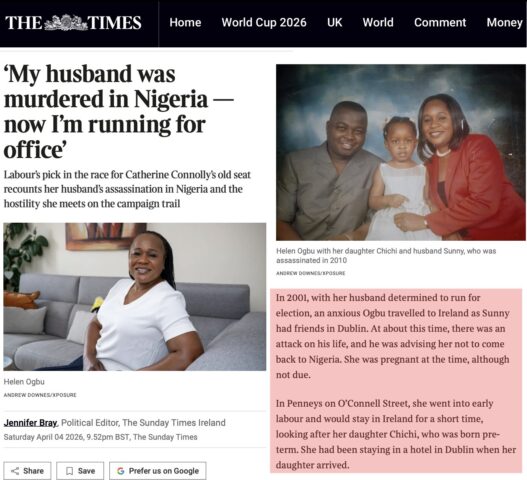
One headline in The Sunday Times from April, just weeks before Ms Ogbu raked in thousands of votes, read: “My husband was murdered in Nigeria – now I’m running for office.”
Given that, I am far from shocked to see people asking whether such headlines gave a misleading impression.
We also know that Ms Ogbu gave birth to a child in Ireland on a short trip in 2001. The Irish Independent reported in May that her daughter has been “born prematurely on a visit to Dublin in 2001.”
This has led to some speculation online in regard to the concerns that had been raised during that period in Ireland regarding thousands of women who had come from Nigeria and other countries and had sought the right to stay because their child had been born here. A subsequent referendum to close the loophole granting such children automatic citizenship was carried by a massive majority with almost 80% of voters supporting the measure.
No-one likes to be asked to address constant speculation, but after all, Ms Ogbu is not just anyone – she could be on track for a seat in the Dáil in the next general election. Sometimes an upfront clarification is the best way to answer critics.
But front runners are often scrutinised, as Jim Gavin and many others know. And Ms Ogbu’s by-election result was Labour’s best showing in the constituency since 2011. She has built a brand on a story centred on resilience and overcoming deep hardship.
Ms Ogbu is a public figure, so a fair examination of her origin story shouldn’t be characterised as an attack or “unacceptable”.
“The Labour Party wishes to express our serious concern at the tactics used by a mainstream media outlet, particularly at a time when Far Right agitation is becoming increasingly evident across our communities,” Ms Ogbu’s party said this week.
They are wearing that excuse thin, in my opinion.
It was Labour that claimed Ms Ogbu came to claim asylum because her husband was murdered, but that narrative is now shifting. Why shouldn’t we find that strange? Why shouldn’t questions be asked and answered?
SCRUTINY
On Saturday, Ms Ogbu’s website was taken down.
Then on Monday evening, following “repeated contact” from the newspaper, the Labour Party said that the wording on Ms Ogbu’s website was “incorrect” but occurred during an editing error and would be amended. The statement from Labour also said that Ms Ogbu arrived in Galway in 2005, not 2006.
Instead of accepting accountability and answering basic questions, Labour is slamming newspapers for simply reporting on errors in a story they repeatedly promoted.
It may have been a genuine mistake, as Labour has claimed. But we simply have to get to a point in this country where we can ask legitimate questions without being labelled racist.
What borders on outrageous is the reaction in the Labour party to the Mail’s journalism and probing of Ms Ogbu. The party showed hesitancy in replying to the newspaper, but it has been swift in issuing a condemnation of the journalist who doorstepped the politician to ask a question of which many want to know the answer.
The party has blasted it as “intimidatory and unacceptable,” whilst the mistake is brushed off as a mere “typo.” The Mirror, RTÉ, The Independent and others have all carried the accusation of intimidation of a journalist and a newspaper who asked a legitimate question.
Essentially, we have a slew of newspaper articles essentially amplifying the same message: It’s racist to question Helen Ogbu, an elected public representative. That is, of course, nonsensical.