What are parents meant to do when the entire curriculum becomes reorganised around a contested idea?
“Social justice” now appears across early childhood, primary and post-primary curriculum documents, and in the National Council for Curriculum and Assessment’s (NCCA) 2022-2025 Strategic Plan, which describes part of its mission as developing young people as “actors for social justice”.
“Social justice” has no single settled meaning, so it is surely reasonable to ask what the curriculum means when it uses this term.
It can refer to a Catholic view, with its emphasis on human dignity, the common good, solidarity and subsidiarity; to a liberal concern for equal rights and opportunity; or to a highly politically charged theory that divides people by identity, categorises them as oppressed or oppressor on that basis, and seeks a radical reordering of society.
These are not different ways of saying the same thing. The latter is fundamentally at odds with the others.
Subject specifications do not only outline how the curriculum will pass on academic knowledge; they explicitly state the aim of shaping children’s values, dispositions and attitudes. To do so in the name of “social justice” falls squarely within the domain of moral development, an area in which the Irish Constitution gives parents primacy.
Classroom materials are already introducing students to controversial social justice concepts based on curricular documents. Louder Than Words, a Junior Cycle English textbook, includes a section on Naomi Osaka wearing Black Lives Matter masks, telling students that she wore the names of black people “murdered by police” to “raise awareness of racist police killings”.
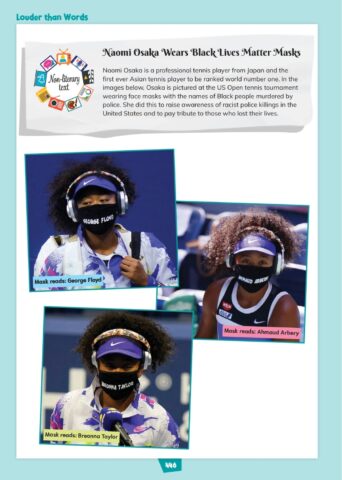
Yet Ahmaud Arbery was not killed by police, the officers involved in the Breonna Taylor case were not convicted of murder, and in neither the George Floyd nor Breonna Taylor cases did the courts establish racial motivation as a factor. The questions that follow unquestionably assume a pro-BLM stance and students are steered toward particular forms of activism based on a misleading presentation of the facts.
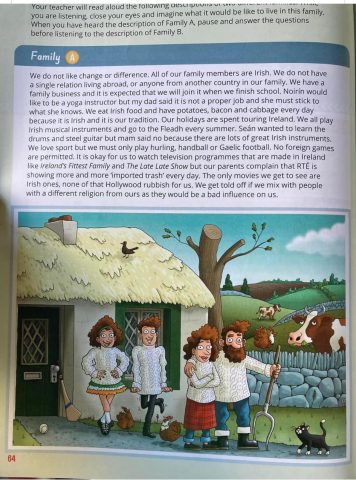
The 2024 controversy over the highly offensive “Family A” and “Family B” exercise showed how a lesson on inclusion can become distorted within a social justice framework, leading to the denigration of certain cultures or groups and the portrayal of them as morally inferior.
Over recent months, I submitted Freedom of Information requests to establish precisely how the NCCA defines “social justice”, and whether it had considered that the term may be interpreted differently during consultations.
I also asked whether the NCCA or the Department of Education had assessed whether integrating the concept throughout the curriculum might infringe parents’ right to determine their children’s moral upbringing. The Department said relevant records “do not exist or cannot be found”. The NCCA initially charged me €300 and released 137 documents. Despite the huge volume of records, none included a clear internal definition of “social justice”, serious engagement with competing meanings, or an assessment of the rights implications for parents.
After an internal review, the NCCA determined that the records did not exist and I was issued a refund.
In other words, there appears to be no documentary evidence that the national curriculum body has confronted the fact that a major value-laden concept, now central to the curriculum, may mean very different things to different parents, teachers, and school patrons.
Deputy Paul Lawless also raised written parliamentary questions on these issues. The Minister for Education’s response sounds reassuring. Social justice, we are told, reflects Ireland’s long-standing commitment to a “democratic, equitable and just society” and is continuous with earlier policy, including the 1999 Primary Curriculum.
All this makes the cross-curricular integration of “social justice” sound harmless, because the term has been bundled with words everyone already values, such as fairness, equality and democracy. It allows the NCCA to borrow their legitimacy while orienting the curriculum toward a much more controversial worldview without saying so directly.
For example, tender documents for an NCCA-commissioned literature review on Intercultural Education, referenced in the Minister’s response, required a glossary defining terms such as “unconscious bias”, “allyship”, “white privilege” and “white saviour complex”. The successful Dublin City University application, which I also obtained by a separate FOI, said the review would incorporate North American “justice-oriented approaches” to diversity, including critical race theory and culturally responsive pedagogy. The authors cited Richard Delgado and Jean Stefancic’s Critical Race Theory: An Introduction.
Delgado and Stefancic are clear that critical race theory questions the very foundations of the liberal order, including equality theory, legal reasoning, Enlightenment rationalism, and neutral principles of constitutional law. This is certainly not consistent with prior educational policy nor is it simply an updated vocabulary for older liberal and Christian ideals. It is a perspective at odds with their assumptions about personhood, truth and justice.
Nearly two years after controversy led to the removal of “white privilege” from the redeveloped Leaving Certificate SPHE draft specification, the concept is now reappearing through whole-school, cross-sectoral guidelines. This is not an SPHE lesson from which a parent can seek an exemption.
Do the differing definitions matter in practice? Yes, very much so. A Catholic account of social justice begins with the equal dignity of every person, made in the image of God. It teaches solidarity with the poor, the stranger and the vulnerable; and it asks children to practise justice, mercy, responsibility and charity.
Critical social justice begins somewhere else. It asks children to understand themselves and others primarily through racial, sexual, class or other identity categories. It gives some voices greater moral authority because of their assumed position within a hierarchy of identity-based victimisation and demands that people be treated differently on that basis.
Take racism as an example. A Catholic approach should teach that every child has equal dignity and that contempt for another because of race is wrong. It says that the colour of a person’s skin tells us nothing about their worth. A critical approach teaches children that race is central to understanding who a person is, and that it should be treated as a marker of privilege, guilt or victimhood. Those are not the same lesson.
This is why the NCCA cannot assume that everyone understands “social justice” the same way. Many Irish parents and teachers, especially in Catholic schools, may hear the term and think of Catholic social justice. But in all my reading, I have not once found this referenced in the relevant curriculum documents. There is, however, significant reliance on critical theoretical frameworks, despite the NCCA and Department’s reluctance to align themselves explicitly with any tradition.
A possible solution to this ambiguity for Catholic schools at least is to develop guidance and practical classroom resources on social justice rooted explicitly in Catholic social teaching. Doing so could help teachers implement the curriculum in a way that is consistent with their school’s ethos, and that affirms the dignity of every child and rejects all forms of racism and prejudice.
Whether Ireland wants schools to adopt a radical social justice agenda should be debated openly. Some parents may welcome it. I suspect many more would object.
But it is indefensible to smuggle in such an agenda by borrowing the legitimacy of cherished ideals and using language vague enough to avoid scrutiny.
If the Department intends to shape children’s values around a highly contested theory of social justice, it must be fully open with parents about what this means in practice. Without such clarity, parents cannot weigh the NCCA’s vision against their own convictions, and the State is in danger of overstepping into a domain our Constitution says it must respect.
________________________________
Kelly Henriques is a mother of four based in Sligo, with a BSc (Hons) and an MSc in Psychology