Dublin City Council often does things that a sober-minded individual could reasonably find objectionable. However, their latest stunt seems to have the approval of precisely nobody, as they have given the green light for plans to tear down the city’s iconic St. Stephen’s Green Shopping Centre and turn it into a mess of brutal-looking bricks and glass.
While the project has been referred to as a mere ‘rejuvenation’, an artist’s rendition of what the result should look like reveals that it is no rejuvenation, but a near-total destruction.
I wouldn’t ‘rejuvenate’ my home by knocking it to the ground. You might as well claim that earthquakes are a naturally occurring revamp opportunity.
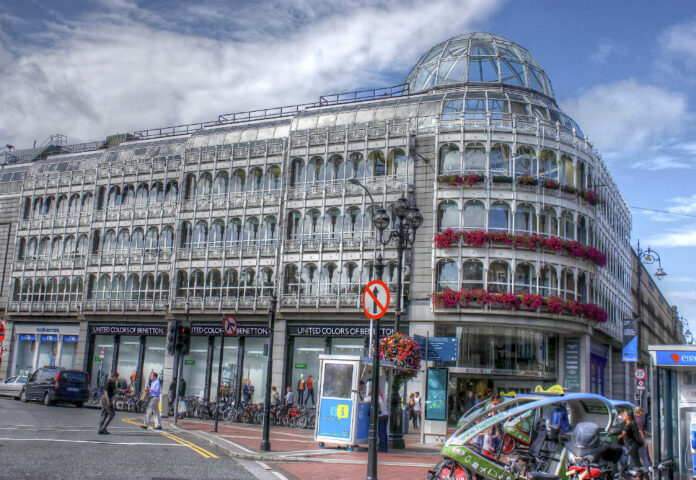
When I look at the building as it stands, I have a deep sense of appreciation for the artistry that went into its design and construction. One commenter compared the appearance of the new plans to an American prison.
As Patrick Vincint wrote, “Why is it necessary to remove one of the most recognisable buildings in Dublin and replace it with a standard-fare modern building that would be easily forgotten as soon as it is out of sight?” Why indeed.
The current structure is reminiscent of a greenhouse flanked with beautiful flower baskets, which looks resplendent adjacent to the stunning park of the same name.
Imagine if you will, Dermot Bannon promised to improve your home by opening up some space in the kitchen, only to completely demolish the entire house and replace it with a mid-sized office block.
Despite over 60, mostly negative, submissions received in respect of the plans, owners DTDL Ltd have been given the go-ahead to permanently alter one of the most memorable of our city’s landmarks.
The plans for St Stephen’s Green have triggered little short of outrage from many of those fond of the beautiful structure, which holds generations’ worth of fond memories for both Dubliners and those from further afield.
A Turkish college friend of mine has a tradition of taking a photograph with her husband in front of the iconic clock inside the centre every time they visit Dublin as a memento of their relationship. I’m sure countless others have their own fond habits and customs formed around the place, which will all be lost, although campaigners appear to be considering an appeal to the An Coimisiún Pleanála.
Part of the plans to redevelop the structure, which replaced Dublin’s Dandelion Market in the 1980s, is to allow for the construction of offices and a cinema. This writer feels somewhat at a loss as to why there is a need for office spaces at that specific location when there are seemingly plenty of such spaces available elsewhere in the city.
There are also plans for hospitality outlets with outdoor terraces, which I expect will be used all of twice a year in typical Dublin weather.
As someone whose entire teenage life revolved around Grafton Street and the shopping centre, I can agree that the type of shops contained within the complex is lacklustre. To illustrate this, there is a Boots, a Starbucks, and a Holland & Barrett in the centre, while there is also a Boots, a Starbucks and a Holland & Barrett only a stone’s throw away on Grafton Street.
A well-thought-out plan for what businesses would best populate the centre could provide the revenue owners want without the risk of irreparable damage or a €100 million price tag.
The idea that this will be wiped from the face of Dublin, never to be seen or appreciated again, is as heartbreaking as it seems profoundly unnecessary. It’s like demolishing Trinity College or the Four Courts and replacing them with prefabs encased in concrete and glass.
As Patrick Vincint wrote last year, “If we have been taught anything by the past few decades of Western culture, it is ‘out with the old; in with the new. ‘ For whatever reason, we and most Western countries have developed a strange obsession with modernising everything: from age-old stories to the definitions of basic concepts like the differences between the sexes. It seems now that even our architecture is not immune to this trend.”