Recent comments by Taoiseach Micheál Martin that Rent Pressure Zones (RPZ) are to be reviewed and possibly replaced have got Ireland’s political and media classes chattering.
In the last few weeks we’ve seen and heard plenty from Ireland’s political heavy hitters gravely intoning on the national airwaves about what a disaster it would be for renters if anyone tampered with rent controls and their related Rent Pressure Zones.
The odd thing is that after nearly a decade of rent controls no one, least of all the journalists supposedly interviewing these people, has asked the simple question as to how successful these same RPZs have been in controlling rents?
Apparently, that’s not how either politics or the media now works in Ireland. Serious minded people – that’s now shorthand for the left or the left-leaning housing organisations – regularly appear on radio and TV making the case for rent controls in the rental sector. But what doesn’t happen is that journalists grill them about the effectiveness of these same rent controls on the Irish rental market over the last decade.
Unveiled in 2016 by then Fine Gael Housing Minister Simon Coveney, Rent Pressure Zones were meant to be the silver bullet that would solve Ireland’s problem of spiralling rents. Rent controls, the theory went, would rein in Ireland’s proverbial greedy landlords by limiting rents increases to 4% per annum. Since 2021, that figure has been further reduced to a 2% annual rent increase. These rules are for existing tenancies – tenancies for new-to-market properties are let at market rents meaning they will invariably be higher.
So how has all of this worked out for citizen Joe and his girlfriend who are now looking for a place to rent in 2025? The latest Daft.ie Rental Price Report sheds some light on their predicament.
It found that in the first five years of rent controls existing tenancy rents increased by 13% while market rents for new tenancies increased by almost 40%. With tighter rent controls in place after 2021, existing tenancy rents have now increased by 7% while new market rents increased by 47%.
If a policy based on rent controls is good news for those in existing tenancies then it’s clearly been a disaster for those entering the rental market and looking for a place to rent. This is in part explained by the report’s finding that in Dublin in February of this year, there were about one third fewer properties available to rent than the average for 2015-2019. Outside of Dublin, that same figure was down almost 60% on the late 2010s average.
The big story from Ireland’s policy of rent controls has been falling rental supply. The significant thing here is that we’re not just talking about new rental stock not coming on to the market. We’re also talking about rent controls and associated hyper regulation causing existing landlords to sell up and exit the rental market itself. This is not just something that affects new tenants looking for a place to rent – mom and pop landlords selling up means that tenants in existing tenancies, who were benefitting from rent controls, now find themselves competing in the much more expensive new tenancy market.
In a word, rent controls have not worked in Ireland because while they have offered protection to existing tenants they have also triggered a sharp fall in rental supply which will eventually catch up even with existing tenancies. Rents increase when demand exceeds supply and rent controls worldwide are known to cause a contraction in rental stock. That’s exactly what has happened in the Irish rental market since 2016.
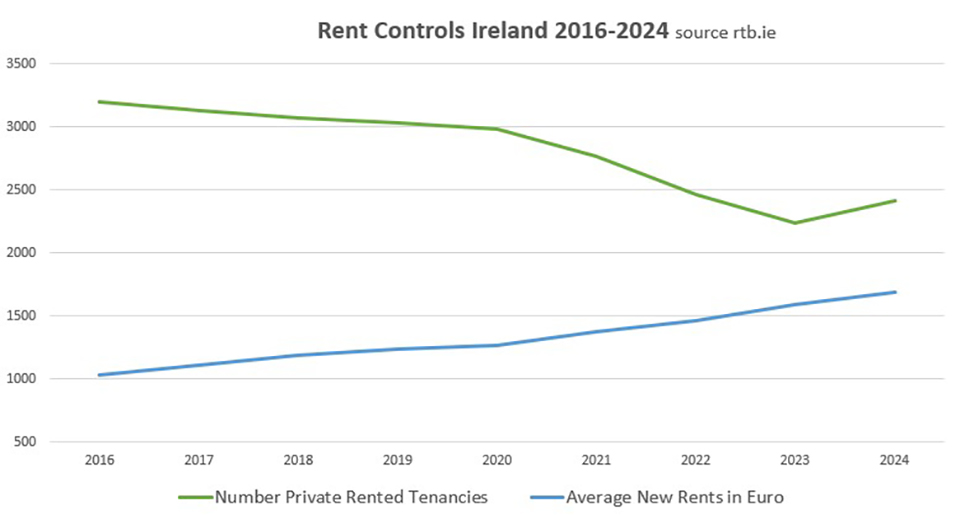
This is well illustrated in the above graphic. One point of interest in this graphic is the uptick in registered private rented tenancies in 2024 which some are talking up as evidence that not only are landlords not leaving the market but are re-entering in numbers. However, this fails to take into account a registration compliance campaign undertaken by the RTB in 2024 which may have resulted in existing unregistered landlords registering. If this is the case, it hasn’t resulted in any new rental stock.
Neither are estate agents talking about seeing a return of landlords something that will easily be confirmed by a visit to daft.ie. Either way, the number of private registered tenancies at the end of 2024 was down almost 25% on the same figure in 2016. This is at the same time that demand has increased with a 10% rise in the Irish population in the intervening years.
What’s rarely mentioned in connection with housing policy in Ireland is that it has been heavily influenced by the country’s influential left-leaning housing organisations and self-style charities. In addition, the Irish political mainstream has drifted leftwards over the last two decades so that even parties like Fine Gael are now effectively left of centre when it comes to housing policy.
This has resulted in a situation whereby since 2021, Ireland has had some of the strictest rent controls in the world. That’s not just the opinion of this writer – it’s also the opinion of Ronan Lyons, Professor in Economics TCD, and author of those same Daft.ie reports.
With a fertility rate of 1.5% (below replacement), housing should be one of the easier problems for any Irish government to solve. Instead, it has become one of the more intractable problems facing Ireland in 2025.
Ireland’s house rental perfect storm is best explained by a government policy of reducing rental supply through rent controls while at the same time increasing demand through inward migration. Ireland’s rental crisis is a crisis resulting largely from the policies that the state has chosen to follow since 2016.
The reason the parties of the left have failed to land a punch on the government over the ongoing housing crisis is that, essentially, the Irish state adopted and implemented their housing policy when it introduced rent controls back in 2016. It is now apparent that it is the ideology that claims that a government can control rents through rent controls that has failed.
So, for the twenty something year old still living upstairs, the more pressing question relates to that factcheck about whether rent controls have actually curbed rent increases? The simple answer to that surely has to be ‘No’.
And as to the supplementary factcheck as to whether those same rent controls might have instead contributed to spiralling rents – the answer is ‘Probably’.