You may have been hearing about a Patrick Sarsfield in the news recently, because researchers hope they may have found his remains in an ancient church in Belgium.
Sarsfield is known for fighting in the Williamite war in Ireland where he was a leader of the Irish troops during the siege of Limerick where he defended the city against the forces of William of Orange.
Sarsfield is also known for his spectacular success in intercepting and destroying a Williamite supply train at Ballyneety, Limerick in 1690 where they destroyed 16 canons and burned over 150 wagons of supplies. He famously entered the camp and, when asked for a password, shouted “Sarsfield’s the word and Sarsfield’s the man.”
He fought for King James II but was eventually defeated. He helped negotiate the treaty of Limerick marking the end of the war.
What did the treaty do?
Following this, the historical “Flight of the Wild Geese” took place involving the exodus of Sarsfield and some 12,000 to 15,000 of his men, plus their families, to France.
In France he rose through the ranks of their military, where he eventualy lost his life in the battle of Landen which is in modern day Belgium.
It is now that things became vague.
There were two theories as to what happened to his remains. One stated that he was buried in the battle ground he fell. And the second is that he was wounded and was transported to Huy for treatment where he subsequently died. Some records indicate that he was buried there with an unnamed French Soldier. It is this theory which forms the basis for these current excavations.
But who was Patrick Sarsfield? He was a Catholic and the second son of Patrick Sarsfield and Anne O’Moore. He had an older brother named William Sarsfield. Patrick married Honora Burke and together they had a son named James Sarsfield .
The Sarsfield family themselves were of English descent, They were wealthy family of Merchants who had maintained the Catholic faith following the Reformation. They came into possession of their lands in Lucan and Kildare as a reward for financial assistance an ancestor Sir William Sarsfield gave the crown during Shane O’Neill’s rebellion.
His father, Patrick, fought for the Catholic Confederacy during the Confederate wars of 1641 to 1652. His mother was the daughter of Rory O’Moore, a Gaelic noble who played a leading part in the 1641 rebellion.
The Homecoming Project
In 2020, Dr Loic Guyon founded the Sarsfield Homecoming Project in the hopes of finding Sarsfield’s remains in order to return them to Limerick, a city with which he is greatly associated.
Dr Guyon was led to St Martin’s Church, a church that is centuries old. where Sarsfield fought for King Louis the XIV in the August of 1693.
St Martin’s church has but one wall still standing after all these years, and above the old church grounds a townhouse was built around 100 years ago.
In December 2023, work had begun on excavating the site: however, recently a breakthrough was made from the cellar of the old building where two unmarked graves were located in which lay the remains of two men.
One of the men discovered was five feet tall who the researchers believe is unlikely to be Sarsfield as he was believed to be a very tall man. The second man was in a coffin that is 1.8 meters long. The skull was very robust, had prominent brow ridges and would have been close to six foot.
These may be the remains of Patrick Sarsfield 330 years after his death, but we cannot be completely sure. Dr Guyon and his team need to use radiocarbon dating to discover how long the remains have been there for and they also need to use DNA tests to truly determine if it is Patrick Sarsfield.
Bones have been taken to be radiocarbon dated while a tooth was taken for the DNA testing. Due to Sarsfield not having any known direct living descendants Dr Guyon had been searching for someone from the same family tree to compare DNA.
There are two prominent branches of the Sarsfield family tree, the branch of Lucan where Patrick Sarsfield belongs and there is also the branch of Cork. Dr Guyon had been contacted by a member of the Cork branch, Tim Sarsfield who was a descendant of a common ancestor of both branches from the 14th century.
Dr Guyon and his team now await results from the radiocarbon dating and DNA tests to determine if they have truly discovered the remains of Patrick Sarsfield.
If they have they will begin the excavation of the site to return the remains to Ireland. If the remains are not of Patrick Sarsfield they will continue the search and focus on the garden area of the site.
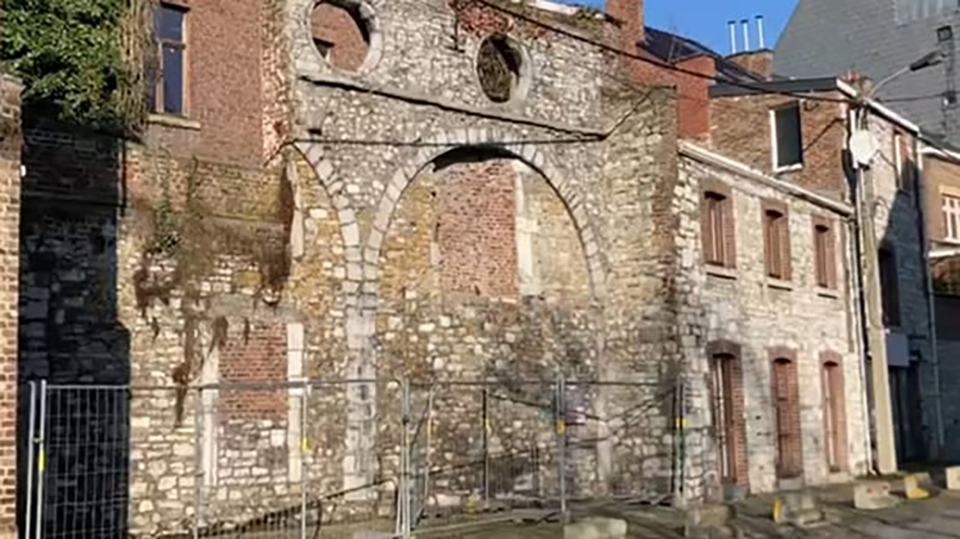
St Martín’s Church in Huy, Belgium
Coilín MacMeanmain is a TY Student