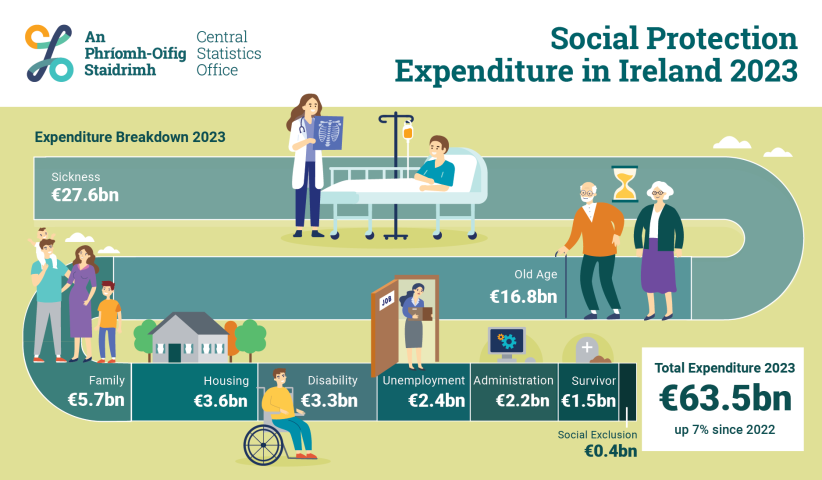
€63.5 billion was spent on Ireland’s welfare State last year, 7% more than in 2022. Temporary protection applicants accounted for the large percentage increase in housing benefits since 2022, up from €2.7 billion to €3.6 billion in 2023, with the CSO citing the war in Ukraine.
The figure is contained in a new report from the Central Statistics Office (CSO) which documents how welfare spending has increased by 37 per cent since 2018, when €46.2 million was spent on social protection. Overall, expenditure by the State shows a splurge in welfare spending, with expenditure increasing by 37 per cent since 2018.
Spending on sickness/healthcare and old age continued to account for the largest proportion of social protection expenditure in 2023 at 70% of the total.
The biggest chunk of spending is in the area of sickness benefits (€27.6bn) followed by old age benefits (€16.8bn) followed by family, housing, disability, survivor and social exclusion. While accounting for a much smaller proportion of total spend, housing is the area which has seen the biggest jump in spending, rising by 33 per cent from 2022 to 2023 and by more than 100 per cent in the five years to 2023.
Commenting on the release, Ciara O’Shea, Statistician in the Government Accounts Compilation and Outputs Division, said: “Social protection is a set of interventions where the objective is to reduce social and economic risk and vulnerability and to alleviate extreme poverty and deprivation.
“Social protection expenditure in Ireland was €63.5 billion in 2023, based on preliminary estimates. Compared with 2022, this was an increase of €4.3 billion or 7.2%. The total expenditure represented 12% of Gross Domestic Product (GDP) or 22% of Modified Gross National Income (GNI*). The main increases were observed in the areas of sickness/healthcare (+€2 billion) and housing (+€0.9 billion).”
When it came to spending on old age benefits (including old age pensions and the provision of goods and services (other than medical care) to the elderly) this increased from €13.9 billion euro in 2018 to €16.8bn in 2023. This represented a jump of almost €3 billion, an increase of 20 per cent. It comes as Ireland’s trend in population ageing is expected to continue, with the number of people aged 65 and over is projected to double between 2011 and 2031, putting a strain on public finances.
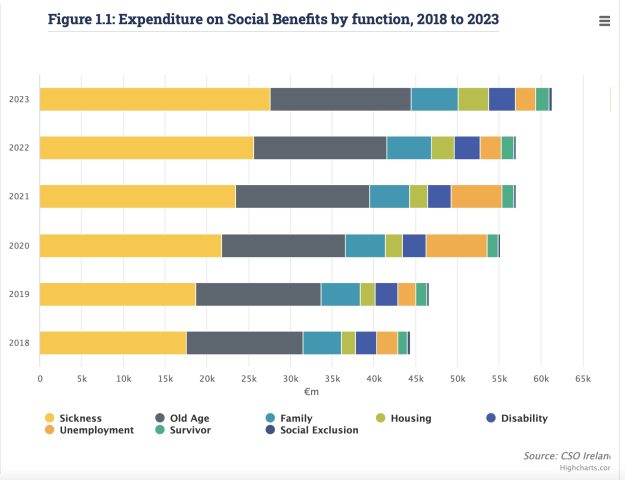
Welfare spending on sickness (sickness/healthcare benefits– including medical care, paid sick leave, and provision of pharmaceutical products) has increased significantly since 2018, according to the figures – up from €17.6 billion in 2018 to €27.6 billion in 2023, a €10 billion increase, and a 57 per cent increase. Every year since 2018, the annual spend on sickness has increased, and rose by €2 billion since 2022, when €25.6 bn was spent.
Spending on housing benefits (including interventions by public authorities to help households meet the cost of housing) has increased from €1.7 billion in 2018 to €3.6 billion last year, more than doubling. 2023’s spend on housing is also an 18 per cent jump on 2021, when spend was €2bn.
“Temporary protection applicants, due to the war in Ukraine, accounted for the large percentage increase in the area of housing since 2022, up from €2.7 billion to €3.6 billion in 2023,” the CSO noted.
In comparison, the State’s spending on unemployment has remained broadly stable compared to 2018, when the figure was €2.5 billion, while it also sat at €2.5 billion last year. It’s a significant decrease on 2020 when Covid lockdowns hit, and unemployment spending surged to €7.2bn and in 2021 when €6.1bn was spent. Compared to 2022, unemployment spending has fallen by four per cent.
On family benefits, including costs involved with caring for family members and in connection with pregnancy and childbirth, this increased from €4.6 bn in 2018 to €5.3bn in 2022 and €5.6bn in 2023, meaning a much smaller increase was seen when compared to housing and old age.
Elsewhere, €5.7 billion was spent on family benefits (including support (except healthcare) in connection with the costs of pregnancy, childbirth, childbearing and caring for other family members), €3.3bn on disability, €2.4bn on unemployment benefits, €1.5bn on survivors benefits survivors (including income maintenance and support in connection with the death of a family member, such as survivors’ pensions). €2.2bn was spent on administrative costs.
There has been some reaction to the figures online, including from economist Dan O;Brien, who pointed out that welfare state spending is equivalent to spending €12,000 per person.
Former Justice Minister Charlie Flanagan, meanwhile, described the statistics as “staggering.”
“These are quite staggering figures bearing in mind that every single one of the 174 recently elected TDs to Dáil Éireann each stood on a platform of increased welfare expenditure and an even more bloated welfare state !,” the former Fine Gael politician said.