A row has erupted in UK football after Crystal Palace and England Defender, Marc Guéhi, wrote the words “Jesus loves you” on his Captain’s rainbow armband for a match against Newcastle this past weekend.
Guéhi has seen his name go viral among non football lovers over the controversy. Take the 92,000 people on Twitter who liked this post, for example, from writer Paul Embery, which read: “Despite being warned by the FA, he did it again in a match this evening. I like this guy.”
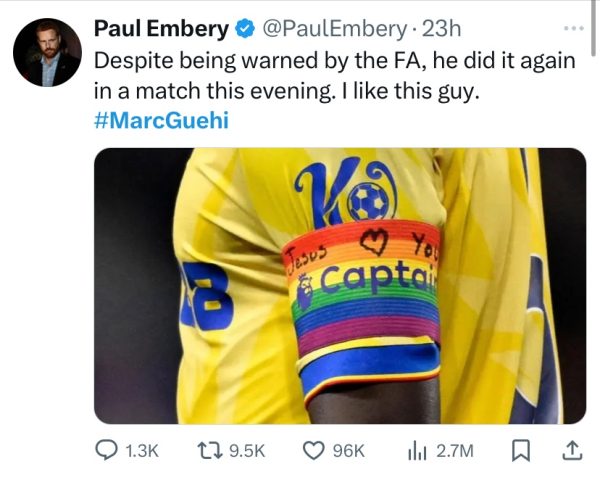
Despite the inevitable panic and alarm from football bosses, the Crystal Palace captain only doubled down – once again refusing to play ball by putting on the ‘Jesus loves you’ armband for his team’s clash against Ipswich on Monday night. Football’s governing body, the FA, has decided not to formally charge Guehi, but issued a caution and said it would write to the Londoner and his club to remind them that religious messages are prohibited.
But people, even in the Rainbow age, seem to be pleased that Guéhi is standing his ground. He has yet to back down over the move that could have seen the 24-year-old Christian formally reprimanded for breaching Football Association rules banning any “political, religious or personal slogans, statements or images” on players armbands. Could it be that beneath all the corporate consensus around pride, there exists whisperings of dissent that until now have not been voiced publicly?
The background to the whole fiasco is that Guéhi, as captain of Premier League side Crystal Palace, had been asked to wear the armband to coincide with Stonewall’s ‘Rainbow Laces’ campaign. First launched in 2013, the campaign asks premier league clubs to use rainbow corner flags and laces as well as LGBT armbands, and has been almost universally observed by players. I suppose we know why, seeing the treatment that this one player has received because of his decision to dissent, even partially (he still wore the armband).
Football Association rules state “For any offence the player and/or the team will be sanctioned by the competition organiser, national football association or by Fifa,” and were clarified last year, with the FA crystal-clear, adding: “Captains must wear an armband which is simple and conforms to the requirements of Law 4 relating to slogans, statements, images and advertising.”
Marc Guéhi was not alone in carrying out some form of perceived protest against the rainbow coloured armband this weekend, with Ipswich Town captain, Sam Morsy, also refusing to wear the symbolic accessory during his side’s clash with Nottingham forest. Morsy, a Muslim, cited religious reasons, and he was not without admirers for having the courage of his convictions.
However, there have been complaints over the playing out of ‘double standards’ in the FA’s treatment of Morsy, when contrasted to Guehi, a Christian.
While Guéhi has been dragged across hot coals, Morsy’s side, Ipswich Town, said in regard to the Muslim player: “We respect the decision of our captain Sam Morsy, who has chosen not to wear the rainbow captain’s armband, due to his religious beliefs. We will continue to grow an environment where all are valued and respected, both on and off the pitch.”
It’s hard not to find myself agreeing with Guéhi’s father, Christian church Minister, John Guéhi, who declared in an interview with the Mail Online that the LGBT community are guilty of “trying to impose on others what they believe in.”
“If you look at what the LGBT community are doing, they are trying to impose on others what they believe in. It’s belief against belief, but at the end of the day everyone has the right to an opinion.” he told the paper.
Is he wrong? He also pointed to the double standards around the treatment of the British Muslim player, and the fact that he was left to his own devices for not wearing the armband. While his son, a footballer who wore the armband but also said he loves Jesus, is given a yellow card for doing so. There is an absurdity in that.
The broader question of course, goes far beyond religion and religious belief. The obvious question is: Why are footballers being forced to make political statements, but punished for making religious ones? If football is really about inclusivity – and not indeed virtue signalling – then why should religion be off limits? Many players clearly have personal faith that they don’t really wish to hide, all whilst being forced to be public campaigners for things like BLM and LGBT causes, both of which are as politically-driven and partisan as it gets.
The politicisation of the game means it has become less about football and more about using the pitch as a stage where big corporations and charities like Stonewall can wage cultural war on the millions of people watching at home. The verdict is in – it’s absolutely not ok for footballers to display religious messages, however they are actually being compelled to support LGBTQ+ issues.
Wearing a rainbow armband is not a neutral act, even if we’ve been well-conditioned to believe it is, and even though it is now demanded as simply the decent thing to do. While the FA argues – applying this in the case of Guéhi – that “political, religious or personal slogans, statements of images” should not be worn on players’ armbands, they have brought politics into sport. There is nothing apolitical about asking premier league footballers to wear rainbow laces and take the knee at games, a gesture of enduring support for the mainly dismantled Black Lives Matter movement.
How can the FA preach about neutrality and not sporting political messages, whilst spending vast sums of money on LGBT action plans and marketing campaigns?
And how could one possibly argue that an armband backing a Stonewall campaign does not, in fact, clearly amount to a political statement? There is also the issue that Stonewall as an organisation is not without controversy – with the Royal College of Psychiatrists amongst others recently cutting ties with the campaign. In contrast, what was so wrong with saying “Jesus loves you?”
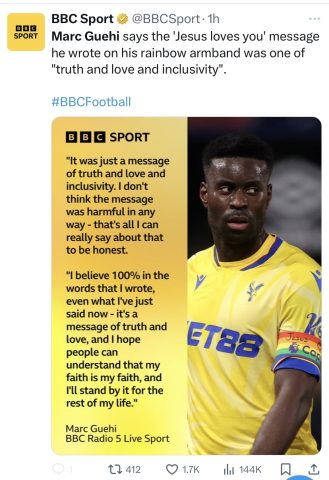
I’d agree with Guéhi that there was nothing wrong with what he wrote on his armband. In fact, it could be seen as being as loving and as inclusive as it gets. Guéhi said in his defence: “It was just a message of truth and love and inclusivity. I don’t think the message was harmful in any way – that’s all I can really say about that to be honest.”
He added: “I believe 100% in the words that I wrote, even what I’ve just said now – it’s a message of truth and love, and I hope people can understand that my faith is my faith, and I’ll stand by it for the rest of my life.”
It should not be up to sportspeople to convey collective messages. And if we are allowing politics to run through the world of football, as it has for over 11 years with the Rainbow Laces campaign, then surely religion should also not be out of bounds. Freedom of speech and identity should also facilitate that parity of esteem.