You may have seen reports this week, including from Gript, that a Dublin city centre parish had cancelled a concert by a gay choir after learning that the event was in essence a Pride event rather than a simple choral recital.
If you saw that, then you likely also saw, or heard, some of the commentary surrounding the story, much of which was not in the Church’s favour. “The Roman Catholic Church is…a fundamentally homophobic institution,” wrote one X user. Another popular take was the usual line about how un-Christian a decision it was, especially from the organisation that claims to be the most Christian of all.
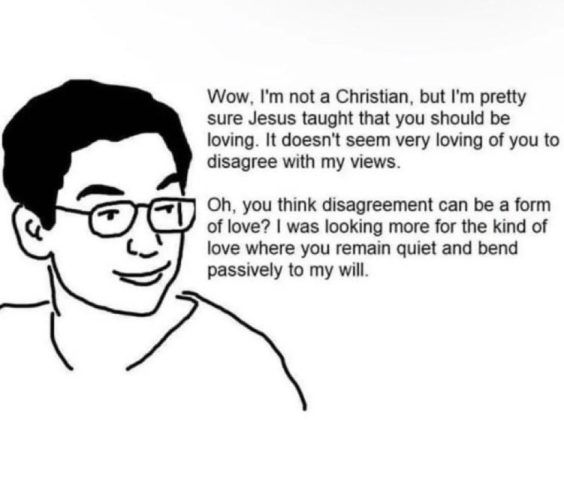
The latter variety of comment brought to mind for me that meme now-famous among online Christians, which features a somewhat snarky looking man accompanied by text that offers – whatever the meme-maker perceived to be – the subtext lurking beneath the surface of so many arguments rolled out against the Church and its stances in modern discourse.
“Wow, I’m not a Christian, but I’m pretty sure Jesus taught that you should be loving. It doesn’t seem very loving of you to disagree with my views,” one version of the meme reads. The same speaker continues: “Oh, you think disagreement can be a form of love? I was looking more for the kind of love where you remain quiet and bend passively to my will.”
I’ll be blunt: This attitude was stamped all over the reaction from many quarters to this particular story. I actually think, and perhaps you’re inclined to disagree and think me naïve, that this incident was a genuine mix-up. The choir – called the Dublin Gay Men’s Chorus – booked into St Andrew’s Church on Westland Row, seeking to make use of the site as a concert venue, which isn’t unusual.
Indeed, in the choir’s statement following the cancellation, they noted that the parish “previously permitted another Dublin-based LGBT+ choir to perform in 2023”. The parish for its part said that it is “happy to welcome groups from all backgrounds to perform concerts in the church,” but that it was disappointed when it learned that “in form and content it is being presented not as a simple choral recital but as a Pride Festival event”.
Speaking yesterday on Today with Claire Byrne, when asked whether it had been the choir’s intention to provoke a response from the church, chairperson Patrick McNamara said “absolutely not”.
So far, so good for my interpretation of the situation as being one of a classic mix-up.
He said that the choir understood the parish’s contention with the event was to do with the title of the performance – ‘Pride in the Name of Love’ – and the use of the word, ‘Pride’. He added that it appeared that the church was happy for them to perform once the choir didn’t “align” itself with the Pride movement, or as he put it, “be our real selves, or show solidarity with our colleagues within the LGBT+ community”.
Moments later, he said that, “If there ever was an issue, and that’s a bigger issue for the Church, in relation to the title of gay men [as in, the choir’s name], it should have been dealt with [at the time of the booking in April]”.
Here, Mr McNamara makes a mistake that he had avoided making thus far, and which the rest of the media seems to have leapt on, if the headlines are anything to go by. For the parish, there was never an issue “in relation to the title of gay men” – as the parish said itself in its statement, it is “happy to welcome groups from all backgrounds to perform concerts in the church”. The issue arises when there’s an effort to force the Church into co-operating with, or facilitating, values that it doesn’t agree with.
As I say, looking at the way this story has been run, who could disagree that this appears to be what’s taking place? “‘Massive upset’ as Gay Men’s Chorus concert cancelled,” wrote RTÉ. “Dublin church cancels concert by gay men’s choir: ‘Deeply hurtful’,” ran PinkNews’s headline. The vast majority of headlines made use of the parish’s phrase “not compatible,” to highlight what could obviously only be understood as Christian bigotry for refusing to go along with an event – so clear to the great and good – about love.
This wouldn’t be the first time significant pressure was exerted by the media in the ongoing clash between more orthodox forms of Christianity and the LGBT movement. Most famously, as readers will likely be aware, a number of Christian-owned and operated bakeries, both this side of the Atlantic and Stateside, were targeted by customers seeking some form of gay confectionery, be it a wedding cake for a gay wedding, or a gender transition cake.
Poor Jack Phillips in the US State of Colorado has been harassed for years by activists insisting that he bake varieties of the things mentioned above, which has resulted in his being dragged before the media and the courts for multiple rounds of modern inquisition. These scenarios, of course, raise a lot of interesting questions about religious freedom.
But they also raise questions about diversity, arguably the most important kind of diversity: Are all forms of diversity to be fostered during Pride month, except diversity of opinion? Is the Church not entitled to its views, just as those attending this month’s pride festivities are entitled to theirs? Ask many of those commenting on the story in recent days, and I dread to consider how they’d answer.