On 20th April in 1879, the first of many ‘monster meetings’ was held by the Irish National Land League, memorable as the inauguration of what subsequently developed into a ‘gigantic’ movement. The meeting took place on a plane, a few miles from Clanmorris, in Mayo. It was estimated that between 15 and 20,000 people were present that Sunday, many of them farmers from counties Mayo, Galway and Roscommon.
The Land League was set up to help struggling tenant farmers, who were suffering a plummet in agricultural prices in Europe from 1874, rapidly followed by bad harvests due to wet weather during the Long Depression. Disastrously, by 1878, many Irish farmers were unable to pay the rents that they had agreed to, especially in the poorer and wetter parts of Connacht. The localised 1879 famine only added to their misery and hardship, and problems were exacerbated because unlike in many other parts of Europe, the Irish land tenure was relentlessly inflexible in times of economic hardship.
In its quest to help poor tenant farmers, the main goal set out by the Land League was to abolish landlordism in Ireland and make it possible for tenant farmers to own the land they worked on. Many of the League’s activists were Catholic priests, with Archbishop Thomas Croke being one of its most influential advocates.
The epicentre of the movement in 1879 was Co. Mayo where 21% of the total number of Land League meetings across the island took place. Early mass meetings at Irishtown, Castlebar and Milltown, Co. Galway resounded throughout the rest of Connacht. In county Down, a second epicentre emerged, with 23 Land League meetings and associated branches founded in the last months of 1879. Between 1879 and 1880, land league meetings more than tripled from 163 to 575.
The origins of the Land League can be traced back to the first of the ‘monster meetings’ to address tenant rights in Irishtown, Mayo, on 20th April 1879. The scale of the meeting was captured in a report carried in The Connaught Telegraph on 26 April 1879.
The paper described it as a ‘grand demonstration’ and ran with the subheading, ‘13,000 farmers’.
“Since the days of O’Connell a larger public demonstration has not been witnessed than that of Sunday last,” the paper reported.
The meeting was presided by James Daly, and Daly, along with John O’Connor Power, J.J Louden, John Ferguson and Thomas Brennan addressed those gathered.
Irish nationalist activist Daly told the crowd gathered about the ‘painful’ experience of seeing hundreds of tenants evicted, as he demanded a lowering of rent. His speech was met with resounding cheers from the impassioned crowd.
As per The Connaught Telegraph, speaking as chairman, Mr Daly said: “We have had a succession of bad crops during the last ten years, and the prospect of the eleventh are anything but promising (“True”). You have a reduction of from 35 to 50 per cent of the value of produce in the last five years … The price of corn, pigs, butter and wool – the staple production of our country – are deteriorated in value to an enormous extent, and up to the holding of this meeting, there is not a move made to affect a reduction of rent in proportion.
“I have had the painful experience of seeing, since January last, in this county alone, at Quarter Sessions, 350 tenants evicted for non-payment of rents, and still the landlords have not made an abatement.
“The work of eviction is going on silently, and how is it to be counteracted unless by public meetings such as this, and by allowing the land of the evicted to stand desolate and waste. Those who take the land of the evicted are the enemies of the country, and are as culpable as the landlords … I read the other day in a Dublin paper of a return of the number of bankrupt farmers in Ireland in 1871; there were 816 as against 2,449 in 1878, with the prospect of an additional thousand in 1879.
“Organise your tenant defence meetings in every parish, and let your agitation be – the land of Ireland for the people of Ireland.”
A number of local land league organisations were set up from the meeting, with the aim of working against the excessive rates being demanded by landlords across Ireland, but especially in Mayo and surrounding counties.
The meeting in Irishtown proved to be the catalyst that set off the Land War. While mass meetings were nothing new in Ireland, with protest meetings having a long history in the west, Irishtown was the beginning of something markedly different.
First, it publicly united antagonistic social groups who loosely shared a common cause, but who were based in contentious social grounds and held conflicting political views. Secondly, unlike the deferential and placatory protests that had been locally organised in the hope of appealing to landlords, the Irishtown meeting articulated national, militant, and retaliative ideas and demands, and established the central principles of the Land War – the elimination of the landlord system and the founding of the present proprietorship in Ireland.
The demands made at the first of the monster meetings went far beyond appeals to landlords for rent relief and demands to the British for moderate land reform. The Irishtown meeting was also successful in spite of clerical censure, and it attracted a large and varied audience representing every class of farmers as well as townspeople.
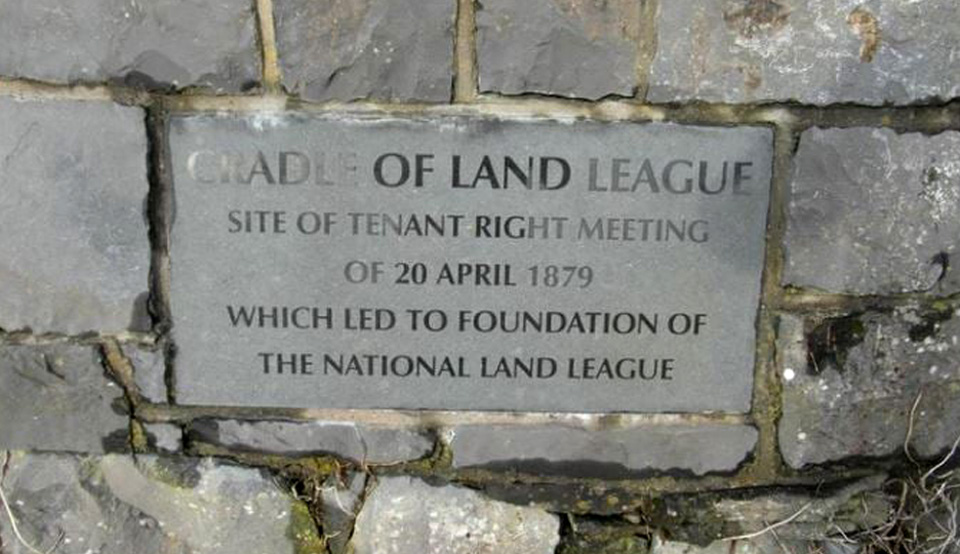
Credit: St Kierans Heritage Association
