A protest in Limerick City has heard claims of inaction by the government when it comes to tackling conditions and chronic overcrowding at University Hospital Limerick (UHL).
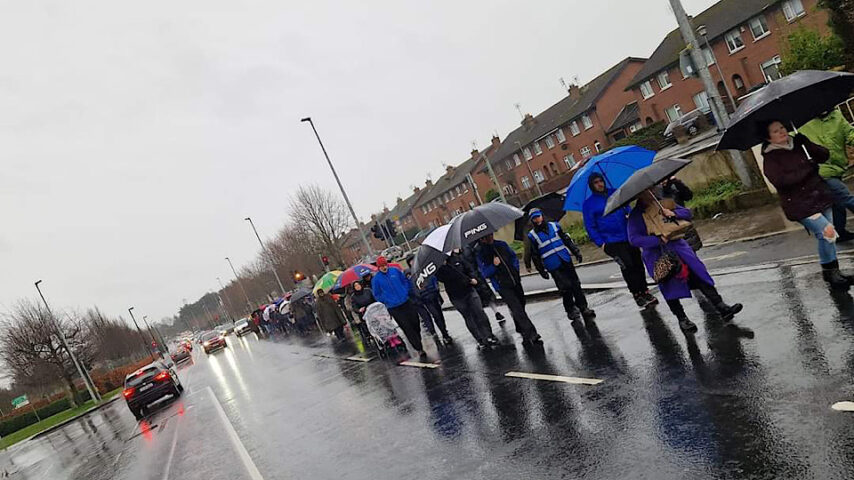
Those in attendance braved stormy weather conditions as they held signs with the message, “We deserve better” – as calls were made to alleviate waiting times at the hospital, and to reopen closed accident and emergency (A&E) departments at Nenagh, Ennis, and St. John’s.
Attendees also highlighted the trolley crisis – as it emerged today that the hospital had hit a new overcrowding record, with 132 patients currently on trolleys at the hospital. The hospital on Monday set a new record for the number of patients without a bed, according to the figures from the Irish Nurses and Midwives Organisation (IM0). Today’s figures are higher than the previous record set by UHL in October, and come 18 months after a team of experts were sent to the hospital to look at the issue of overcrowding.
Of those currently on trolleys waiting on a bed at the hospital, 61 are in the emergency department.
Hundreds attended the Saturday’s protest in wet and windy conditions, which heard claims the government has so far “ignored” the call to action of 11,000 people who protested conditions at UHL one year ago. 12 months on, those gathered heard that conditions at the hospital had worsened, with “many serious incidents” occurring of late.
Braving Storm Isha, over 500 people marched from the Crescent Shopping Centre in Dooradoyle to the gates of the hospital, one year after 11,000 people gathered at a protest highlighting conditions at the hospital in the wake of the death of teenager Aoife Johnson.
The government has “no plans” to address the overcrowding crisis, attendees heard.
Health campaigner and organiser Mike Daly, whose father, Michael Daly Sr, died due to medical negligence at the hospital, said he believed that the only solution is the reopening of A&Es, which he said would alleviate the “chronic, massively overcrowded” A&E at UHL.

Mr Daly called on Health Minister Stephen Donnelly to either open up closed A&Es or to have a fully functioning A&E at Barringtons Hospital in Limerick.
“Not only will that alleviate the overcrowding and bring it down to normal levels,” he said, “But it would also sort out the beds problem at UHL, with all the beds available at Barringtons.”
Speaking on Saturday, Mr Daly suggested a compulsory purchase order of Bon Secours, formally known as Barringtons Hospital.
A compulsory purchase order, he said, could be made based on the grounds for the common good.
“That is a suggestion,” he told the rally. “One of many, but for the most part, we are calling for the reopening of the three A&Es at St. John’s, Nenagh, and Ennis.”
“It’s incredible and absolutely unacceptable,” he added, “That we have only one A&E in the whole of the MidWest catering for over 425,000 people. It’s unsustainable, and the overcrowding issue will never be solved unless we have more A&Es. The likelihood is that more people will die needlessly. We cannot and will not accept that.”
Mr Daly continued: “If the government can spend billions renovating hotels and buildings for refugees, then they can spend a few million modernising the three A&Es to operate as filly and functional, in order to resolve the overcrowding, and most importantly, to stop needless deaths. That should be paramount to them.”

“We cannot and will not accept that nothing is done. The government must immediately sort out the overcrowding that is killing people needlessly,” Mr Daly told the crowd.
“We cannot stop until this is done.”

In December, it was revealed that tragic schoolgirl Aoife Johnson, 16, died after a “litany of failures” at the hospital. The teenager, who died of bacterial meningitis at UHL, waited 12 hours in an overcrowded emergency department in December 2022, before she was treated for sepsis, while her family desperately tried to alert staff of her deteriorating condition.
A review into the sixth-year student’s care found there were delays in her treatment, which breached national guidelines on the management of sepsis. She passed away in the hospital on 19th December 2022, two days after she first attended the hospital.
While Aoife should have received treatment within one hour of diagnosis, the damning review highlighted multiple failings and missed opportunities during the first 12 hours she spent in the hospital.
Last month, during a Dáil debate, Deputy David Cullinane spoke of the need for more beds, telling the Minister for Health that capacity remains a problem.
“I have visited five hospitals over recent weeks. I have spoken to many managers of hospitals, but also people who work on the front line, including nurses, doctors, consultants and healthcare assistants,” he said.
“Every single hospital is doing its best to deal with very difficult circumstances at the moment with rising infections in the community. Staff are working wonders, but they are burned out and there is a lot of fatigue. Managers are also doing their best. At every single hospital I have visited there are plans for more beds. The hospitals need more beds, surgical theatre capacity and diagnostic capacity.
“They also do not have the option, in many cases, of sending people home because the home care is not there and we do not have step-down or recovery beds in the community, yet over the past 24 hours the Minister for Health seems to be blaming everybody bar himself. It seems to be the management of the hospitals and the staff who are not doing enough, but the Minister needs to take responsibility […].”
Last week during a Dáil Éireann debate on hospital overcrowding, Health Minister Stephen Donnelly was asked for his views on the “significant levels” of overcrowding at University Hospital Limerick, and what surge capacity measures had been adopted in the past 12 months.
He said that the Emergency Department at UHL “continues to manage high volumes of patients attending and like many EDs around the country is currently seeing a surge in patients with respiratory conditions. In 2023 the ED had 80,000 presentations,12% more than 2019.”
“Significant additional investment has been provided to University Hospital Limerick in recent years, including the opening of 150 additional beds in the UL Hospital Group since 1st Jan 2020 – 98 of these beds have been in UHL,” he told the Dáil.
During the debate, TD Peadar Tóibín said there had been “really worrying” trends regarding the numbers of people suffering on hospital waiting lists and in accident and emergency departments due to the recruitment freeze.
“It is important that we start to analyse how many people are suffering as a result of this situation and how many people are losing their lives in accident and emergency departments now in this State,” he said.
“Not for a moment am I going to downplay the real pressures in too many of our hospitals for too many of our patients in accident and emergency departments,” the Health Minister said in response.
“However, it is really important that as an Oireachtas we acknowledge the progress our healthcare workers are making. I can tell the Deputy, and I know he will have seen this himself from talking to them, they are working so hard to bring down the number of patients on trolleys in every hospital. There has been a national response to this situation.”
“I 100% acknowledge the work that the staff and medical professionals within hospitals are involved in. My critique is of the lack of Government investment and the lack of reform in the HSE,” Mr Tóibín said, adding:
“We see from talking to family and friends, from our constituencies and communities and from newspapers, television and radio that there are serious problems with people suffering adverse incidents in hospitals and with people waiting for so long that they are not getting the necessary treatment. We need to get to the bottom of this to make sure this does not happen in our hospitals in future.”