Garry Bannister’s new Irish-English Thesaurus is both a prayer book and a user’s manual
_ _ _ _ _ _ _ _ _ _ _ _
As the Irish language limps its way through another century, those of us – this writer included – who have learnt and are learning Irish may be finding it a little bit more difficult to keep our Irish polished and rich in idiom. Just as the influence of English, a global language, has rubbed away at what used to be called Hiberno-English, so too has its influence seeped into the Irish language, both in the speech that native speakers use and through the ‘professionalization’ of the Irish-language sector and its attendant, essentially anglicised, documentation with its tortured language of grant and favour.
To that end, few good writers in Irish will not find themselves diving into their dictionaries to find out what a word means, what it might mean and how it might be marshalled to convey a sense of the past but resonate with a modern audience. Traditionally, the two stalwarts in contemporary times were the de Bhaldraithe and Ó Dónaill dictionaries. True Spartans would often have a copy of Dineen’s on the shelf too – a back-up for a deep dive. De Bhaldraithe and Ó Dónaill have since been joined by a new English-Irish dictionary, published by Foras na Gaeilge.
The late great Monsignor Breandán Ó Doibhlin also produced a small book in Irish which he termed “an analogous dictionary” and many Irish speakers will have had a number of books of cora cainte, sayings, on their shelf to provide little insights into language usage and how words twist and turn in the wind over time.
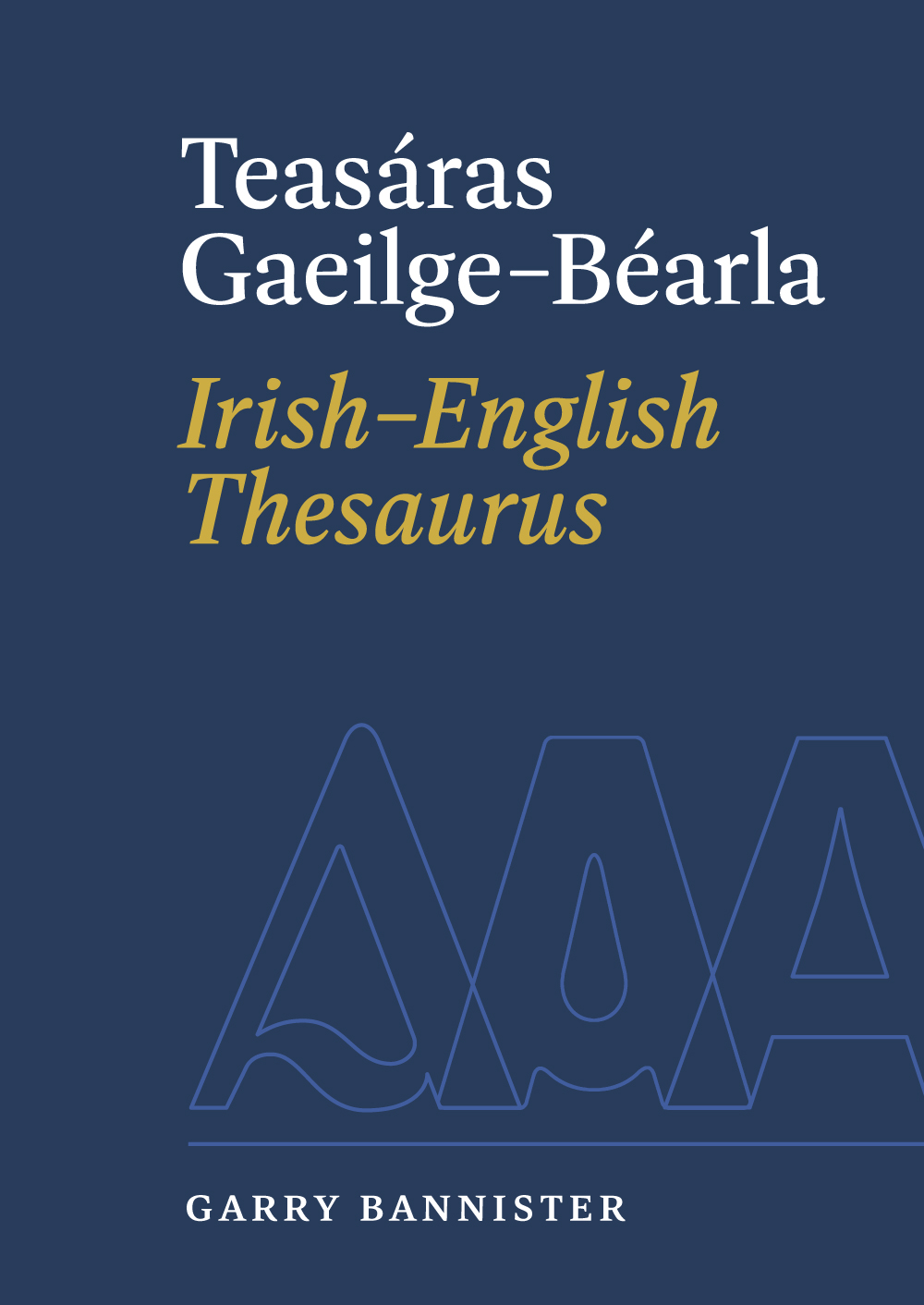
In that regard then, there are few Irish speakers who will not want to go out and buy a copy of Dr Garry Bannister’s new work, Teasáras Gaeilge-Béarla/Irish-English Thesaurus (New Island Books), a monumental treasury of terms and usage which will provide a lifetime’s learning to whoever places it on the shelf. Bannister is a teacher, academic and translator of long-standing and the fruit of his very many years of labour in those fields are to be seen in these pages. Here indeed is a harvest to feed the spirit.
Yes, of course, you can look up Irish online at tearma.ie but, damn it, you are an Irish speaker. Where is the romance in online? The revival of Irish is intimately connected with publishing, with books, beautiful little Irish-filled objets d’art which appeared, miraculously, at the beginning of the last century, and echo, in their lovely ink, paper and covers, an older age of manuscripts and learning. The living Gaeltacht survives in beautiful books and because of beautiful books.
That too must be the hope for Bannister’s magnificent tome; some 700,000 words – nouns, masculine and feminine, adjectives and adverbs – translations, expressions, proverbs and a splash of grammar, all presented in a well-produced book of a thousand pages. Simply put, it is both a prayer book and a user’s manual; giving practical examples of word usage while, simultaneously, raising the soul of any lover of Irish.
I mentioned ‘lover’. Bannister provides many examples of the word in his entry. Here are a few as a taste of how his thesaurus works: leannán eitithe, spurned lover; leannán geal, sweet heart; leannán glas, toyboy; leannán leapa paramour, mistress; leannán luí concubine; leannán mhídhílis cheat, unfaithful lover; leannán rúin, secret lover; leannán sí phantom lover; sickly person, person with waning health.
He then provides a little thumbnail sketch of leannán sí: “fairy/phantom fairy – sometimes it was believed that a youth, especially a young man, with weak and failing health was being visited at night by a leannán sí who was draining his life-force from him. In this way, the term was then applied to any individual who was sickly and would have been expected to have had better health. The term is also used to express the meaning drochanáil baleful influence.”
The book is speckled with such observations and musings, little lines that immediately clarify and deepen one’s understanding of a word and its genesis.
The description leannán glas/toyboy was one that struck this reader for its clever use of the adjective “glas” which can mean both “green” (or “grey”) in colour but also in experience. Ó Dónaill references “glas-stócach” meaning callow youth, half-grown boy. The term “leannán glas” was not one with which this writer was familiar but it leaps of the page and you think, straight away: “Of course! Toyboy! What else could it be?”
It combines two well-established words in Irish and presents them in such a way as to make them serviceable for a modern generation.
You think I am talking raiméis, drivel, do you? Are you sure I am not talking alamais, balderdash or amaidí, nonsense or brilléis, gibberish or bundún, twaddle, or cacamas, crap? Am I full of futa fata, confused talk, or gaoth mhór, empty talk or mugadh magadh, humbug or plob plab, blubbering nonsensical talk or treillis breillis, codswallop?
Who knows? What I do know is that this astounding book will take its place on many an Irish speaker’s shelf and, in years to come, when a question over a word and its meaning and use arises, the shout will go up: “Cuir ceist ar Bhannister! Ask Bannister!”
There can be no greater compliment.
Faigh é anseo: https://cic.ie/shop/ag-foghlaim-gaeilge/focloiri/teasaras-gaeilge-bearla/