The recent Business Post/Red C opinion poll put support for the combined FG/FF/Greens at 42% – not bad for a government that, in the opinion of many, is literally running the country into the ground.
Sinn Féin, the main opposition party, actually dropped 5 points to 29% in the same poll. It’s not like this was some flash in the pan either – a recent Irish Times/Ipsos MRBI opinion poll put support for the coalition at 43% with Sinn Féin again down 4 points.
The reality is that if there was an election in the morning, a government that not only has an appalling record on health and housing but one that has also been actively cannibalising the country’s hotels, student accommodation blocks and even nursing homes has more than a sporting chance of being returned to power. It’s a sobering thought especially when you consider that the same government is now busily passing laws to curb freedom of speech, all of which the Irish people are strongly opposed to if you are to believe the same opinion polls.
Perhaps the big mistake that Irish political pundits have been making in recent times is in tracking the fortunes of individual parties in opinion polls rather than looking at the big picture of where Irish people now see themselves politically.
The recent 2023 Reuters Digital News Report had an interesting take on this when it asked Irish people to identify themselves on the political spectrum.
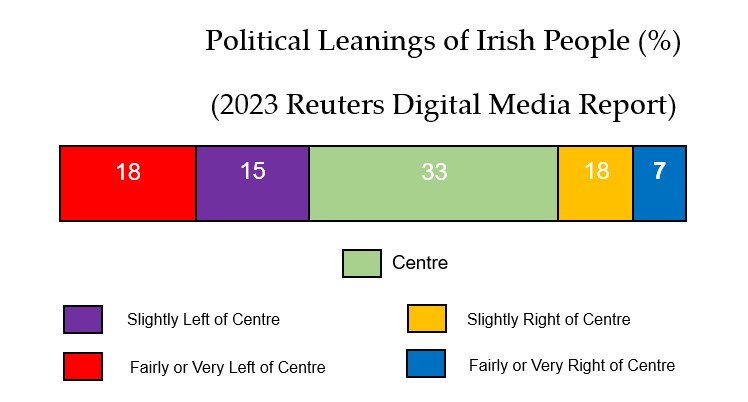
The real story here is that one in three Irish people now identify as either slightly left of centre or very left of centre. Significantly, a poll of Ireland’s key power players such as the media and NGOs would, in all likelihood, show them to be even more left-leaning than the general population. Ireland is now a country of the left – not the centre and certainly not the centre-right. It is against this context that opinion polling in modern Ireland should be assessed.
In recent times, the spectre of the ‘far-right’ is frequently raised in Irish political discourse but what these figures also show is that, in terms of the extremes, it is the far-left not the far-right that is the more dominant feature of the Irish political landscape. Indeed, these days you would have to ask if Ireland even has a centre-right political presence?
Commentators like to make a lot of play about Fine Gael and Fianna Fáil being right wing with the number of landlords in Dáil Éireann usually being trotted out as proof positive of this. Yet the label is hardly appropriate for two parties which are now devoted supporters of high tax, high spend policies with an ambition for ever more state involvement. These policies alone would get them dumped out of any self-respecting centre-right party in Europe – and that’s before you even get to their support for things like gender ideology or curbs on free speech.
For Ireland’s left, the main challenge now comes not from the far-right but from the broad mass of centre voters. In this respect, their task involves corralling the centre and ensuring that it does not wander off-side to the centre-right. This is done largely by constantly warning centre voters about the perils of engaging with the mythical ‘far-right’. Political Ireland’s bogey man ‘far-right’ now appears to exist more to serve the needs of the left than the right.
In many ways, support levels for individual parties are almost irrelevant at this stage as most parties subscribe to the same broad centre-left policies anyway. Differences hinge more on personalities than policies. Is Micheál as affable as he seems? Is Leo as cool as he likes to portray? Is Mary Lou really as edgy as those Sinn Féin slogans would suggest? Does Eamon even own a car these days?
This is inconsequential political fluff which doesn’t alter the fact that most if not all political parties in Ireland now operate within the same centre-left political world view. Vote for one or all of them and you’ll still get broadly similar policies focused on a high tax, high spend, state-centred country living in constant dread of being taken over by the mythical ‘far-right’.
Readers of a certain age will recall how one of the Labour Party’s slogans in an earlier age was that ‘the seventies will be socialist’. Well, that didn’t happen in the 1970’s at any rate and even at their electoral highpoint in the 1990’s, Labour never actually managed an electoral breakthrough of note.
However, what did happen was that Labour eventually got to control the political narrative in Ireland changing it from centre-right to centre-left. The election of Mary Robinson as President in 1990 may well have been the real turning point for that.
The Ireland of the last 30 years is, above all else, the Labour Party’s Ireland. In this respect, it favours a big state, leans left on economic matters and is aggressively liberal on social matters. Not only is this the FG/FF/Green vision for Ireland – it is also Sinn Féin’s vision which might well now explain their mixed fortunes in the polls.
The Labour Party may never have gotten the popular electoral mandate it dreamed of but its centre-left narrative did take hold to the extent that former conservative parties like Fianna Fáil and Fine Gael gradually adopted Labour’s policies. Today, it’s not just Sinn Féin, the Social Democrats and the Greens – all Irish political parties could now be considered to be versions of the Labour Party.
What the opinion polls are now effectively telling us is that there is no political opposition in Ireland. That is why the polls haven’t recorded any significant changes in public sentiment over the last two years and it might also be an indicator that they won’t be doing so in the run up to the next general election either.
Perhaps, when Labour vowed that ‘the seventies will socialist’ all those years ago this is what they meant – the country would not have a political opposition. Ireland is now a country of the left with a socialist political culture and the main thing that opinion polls can tell us now is not whether Fine Gael, Fianna Fáil or Sinn Féin are up or down a few percentage points but whether Irish people are happy to have it that way.