This week, a 34-year-old British woman was handed a 28 month sentence (14 months on license) for causing the death of her late-term unborn baby using abortion pills. She acquired the pills illegally by providing false information to abortion provider, the British Pregnancy Advisory Service (BPAS).
Stoke on Trent Crown Court heard how Carla Foster, 34, a mother to three young boys, felt “deep and genuine remorse” for causing the death of her baby girl, who was between 32-34 weeks gestation, using the lethal pills – which are permitted up to ten weeks gestation in Britain.
The horrible incident, which saw the baby born, not breathing, while Ms Foster was on the phone to ambulance staff, happened in May 2020, after Britain ushered in a “pills by post” abortion scheme during the first lockdown.
While schools and churches were forced to shut their doors, family businesses shuttered (and many never reopened again), and our most vulnerable were plunged into devastating social isolation, abortion was deemed an “essential” service. This special treatment to protect an abortion regime which has become the UK’s golden calf, saw the British government amend the law “temporarily” to make it legal for women to abort babies up to ten weeks’ gestation at home.
This was something the government claimed would “reduce the risk of transmission of COVID-19 and ensure continued access to abortion services”.
Of course, it’s little surprise that the system remains in place today – even despite an investigation from last year proving babies are being born alive after mothers took abortion pills later in pregnancy. Ambulance staff at some NHS trusts were even provided with baby mannequins to identify late-term babies, GB News found.
Handing down the sentence, Judge Mr Justice Edward Pepperall said that while Ms Foster felt “genuine remorse” for her actions, it was his duty to apply the law as provided by Parliament. It came after Foster pleaded guilty to a charge of section 58 of the Offences Against the Person Act 1862, administering drugs or using instruments to procure abortion.
He said he could not ignore the fact that the evidence presented to the court, from internet searches, was indicative that the 34-year-old knew she was pregnant for three months, having searched for “how to hide a pregnancy bump” and “how to lose a baby at six months”.
In sentencing remarks, which make for deeply unsettling but illuminating reading, Judge Pepperall detailed the “attachment” Ms Foster had to her unborn baby, a little girl who she named Lily, and the fact she had been “plagued by nightmares and flashbacks” of the child’s death.
“I accept that you feel very deep and genuine remorse for your actions. You are wracked by guilt and have suffered depression,” he said. “I also accept that you had a very deep emotional attachment to your unborn child and that you are plagued by nightmares and flashbacks to seeing your dead child’s face,” he told Foster.
Reading this, one must wonder: do those in the abortion industry – namely BPAS who sent the pills without checks – and the campaigners and politicians like Stella Creasy, ever feel even the slightest tinge of guilt? Do they too suffer from nightmares and flashbacks?
Clearly they they do not. In a statement, the abortion giant’s chief executive Claire Murphy said BPAS were “shocked and appalled” at the decision to send Foster to jail, and in textbook ‘exploitation of a tragedy’ style, urged MPs to protect women in desperate circumstances so they are never threatened with prison.
The commentary around the case has been less focused on the disastrous, galling results of allowing women to access abortion pills without any in-person consultation or checks. It has focused even less still on the humanity of an eight-month-old unborn baby, and the pain and terror that little girl must have felt, and more about the alleged cruelty and injustice of sending Ms Foster, a woman, to jail – simply because she is a woman, and a mother.
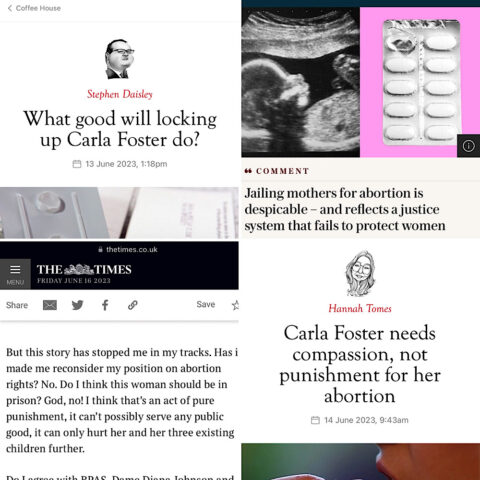
“What good will locking up Carla Foster do?” Spectator columnist Stephen Daisley asked, reasoning that “a real woman and her suffering lie at the heart of this case”.
He wrote that he struggled to see how sending Foster to jail would further the ethical interests asserting the value of the life of her child alongside her own interests as a pregnant woman, “when set against the circumstances of the case and the likely impact on her and her children”.
Suzanne Moore for The Telegraph wrote that jailing mothers for abortion was “despicable” – reflecting a justice system that “fails to protect women”. Polly Vernon, writing in The Times, gave a vehement and impassioned defence of Foster (who she refused to name), writing that sending her to jail was “an act of pure punishment, it can’t possibly serve any good, it can only hurt her and her three existing children further”.
The argument that because this lady has three children at home, who still need care, she should have received a suspended sentence – or no sentence at all – has become the dominating conversation this week. On social media, many reposted comments shared by Ms Foster before her sentencing, which read, “No one has the right to judge you because no one knows what you’ve been through”.
Anyone who has pointed to the high survival rates for children born at eight months – which is as high as 95% – and the fact this child’s life had immense value, has been decried as a sanctimonious, nauseating moraliser.
But I find the argument that Foster shouldn’t have been locked up just because she is a woman with children at home, one of whom has special needs, absolutely extraordinary. Would we make the same argument for a man? Of course we wouldn’t. Not in a million years – because it doesn’t make sense, nor does it make the crime in question any less criminal.
We would never say that a premeditated killing by a father of his child should be excused on the basis that the perpetrator was a dad, with children at home – so why on earth do we make this argument for women?
Statistics show that young men who grew up without a father are more likely to end up in jail. Yet, no one argues that many men who have committed violent crimes should be freed from jail because they experienced a difficult or traumatic childhood without a dad. The overarching commentary around this case has exposed a default sympathy for women, and women alone, which would never be extended to men.
In response to Foster’s tweet about “not judging” people based on what they have lived through, does that mean we should open all prisons and release violent criminals because they experienced trauma in their lives prior to committing crimes? Surely, reasoning by emotion alone only gives way to anarchy. We must judge certain actions objectively as either right, or wrong – that is what the law is for.
The reaction has also shown that abortion campaigners and some journalists indeed think it is completely fine to abort a child right up until the moment of birth, because the mother has an inherent right to do so, solely because she is a grown woman.
For seasoned pro-lifers, this will come as no surprise, but to the British public, who have for years accepted abortion as a cultural pillar — citing arbitrary time limits as a moral guideline — it is eye-opening to see so clearly that abortion advocates do not believe in time limits after all. But let’s face it, to believe in putting a time limit on abortion would undermine the whole concept of being ‘pro-choice,’ wouldn’t it? (Abortion lobbyists have themselves pointed this out).
Drawing a line in the sand defining when it is right to kill an unborn child has long been a smoke-screen, when all along, the only logical and moral point at which we can define a child’s value is at conception, the point at which that unique life comes into existence.
Another critical issue, which has been quenched with noisy media outrage over Foster’s sentence, is the UK’s continued reliance on abortion pills by post, and the way in which the abortion industry is never held to account for the way it treats babies and women.
As per BPAS’s own 2021-2022 report, the largest provider of abortions in the UK only saw 5% of clients face to face. It is clear that telemedicine abortion remains a money-saving business model for the abortion giant, which performed 93,136 abortions in the year up to March 2022, and lost £4 million in the last five years (citing its failed fertility business) – making it desperate to claw back cash.
BPAS’s latest annual report admits it now serves 95% of clients by “telephone only” – (a business model which the Royal College of Gynaecologists (RCOG) has suggested should yield savings of £1.2 million per annum). I dare you to tell me that abortion is still ‘all about women’?
Indeed, the Care Quality Commission (CQC), which published its latest report on BPAS on 1 June, said it was concerned that the delivery of “quality care and services” was put at risk by “financial challenges and finance-led decision making”.
Other problems noted by the watchdog included “inconsistent governance, oversight, and monitoring to ensure patient safety” at BPAS.
In the context of this week’s case, those who have reservations about an abortion performed on a baby at eight months have also been scolded about being judgemental – with abortions like this stressed as ‘rare’. But, BPAS’s own 2021/22 report makes it apparent that late-term abortions are not as rare as we have been led to believe. 80,201 abortions they carried out were early medical abortions in 2021/22 – meaning that in one year, there were 12,935 abortions which did not fall into the category of being early (under 10 weeks).
Surgical abortions (mainly performed after ten weeks) rose from 11,230 to 12,772 from 2020/21 to 2021/22, an increase of 1,492, the abortion provider stated. It may also be worth noting that the latest annual abortion statistics from the UK show there were 276 recorded abortions performed at over 24 weeks in 2021 in England and Wales.
While just one percent of all total abortions were carried out after 20 weeks in 2021, that still amounts to roughly 2,140 late-term abortions performed at 20 weeks plus in one year, a trend which has remained mainly consistent in recent years.
2,000 babies aborted at six months gestation doesn’t seem all that rare, when it’s framed in this context, does it?
To come back to the tragic case of Carla Foster, while my sympathy goes out to a woman who has been left devastated by her actions, and her unborn child who died in such an awful way, as well as her family and those left to pick up the pieces, her crime remains a crime – and that doesn’t change just because she is a woman.