Matt Treacy’s article on “An bata scóir” made me think on my research about how Shane Leslie, an Irish writer, Catholic convert and member of the Gaelic League, collected 5468 signatures of Irish children from northern counties (Co. Monaghan, Louth, Tyrone and Donegal) to his appeal of moral support for the Polish children.
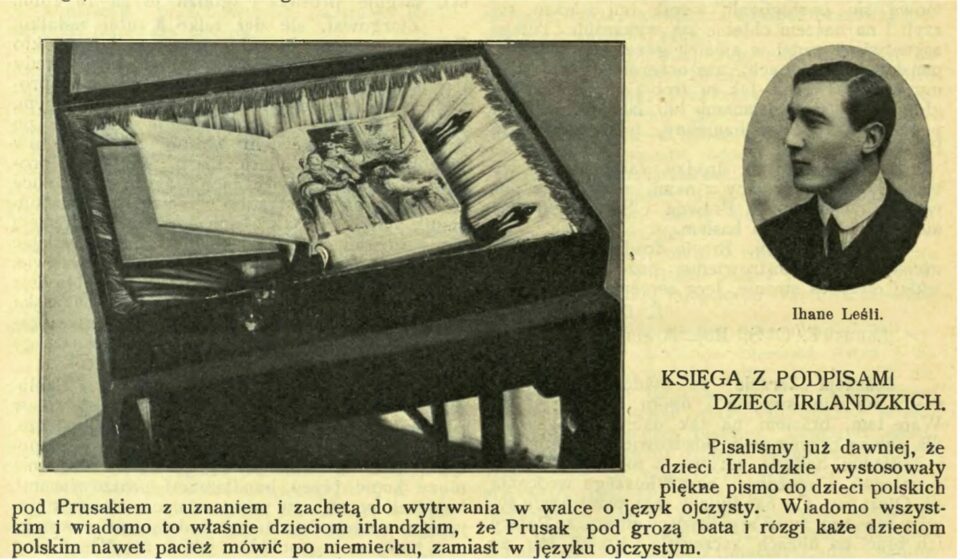
The bound signatures are in the Czartoryski Museum in Cracow, Poland; many Irish names in Gaelic script which could mean they were collected by teachers during Irish classes. No account of this action has been found by now in Irish newspapers of that time, but there were articles published in Austrian part of Poland, beyond the Prussian censorship competence area, some with incorrect spelling of Leslie’s name.
The Commonwealth of Poland and Lithuania ceased to exist in 1795, when the country had been divided between Russia, Prussia and Austria. Ireland and Poland, on the opposite corners of Europe, became very sympathetic to each other at least from the late 18th cent, when the United Irishmen were interested in Kościuszko, and Polish writers translating Macpherson’s Ossian discovered the fragment where “Kukullin” (Polish spelling for Cú Chulainn) vowed to defend Erin from Northern invaders. Both countries had their own oppression and their heros.
Browsing through Irish newspapers, one can observe a frequency of references to Poland in times of political upheaval, turmoil or any spectacular developments on the Vistula. At the same time, whenever censorship allowed, Polish newspapers were writing on Ireland when something was happening on the banks of Shannon. Not always there was detailed knowledge about the sister country, but the affection kept living. In 1848 aplenty of articles were printed in Prussian Poland about Ireland, with sympathy for the starving people but also for the rebels. A bit bigger rebellion and a smaller subsistence crisis also happened in Prussian Poland at that time – the land was with just more diverse agriculture, and not that many absentees. In 1863 when Poles and Lithuanians were fighting another hopeless anti-Russian uprising, the veteran of the Young Ireland and British prisons, William Smith O’Brien traveled long away from Kraków to Vilnius and later gave a lecture in Dublin, supporting the insurgents.
In the turn of the centuries, Poland was divided between Russia, Prussia and Austria. The situation in Austrian Poland was relatively good, unlike in two other parts. In Prussia it was increasingly bad, with official colonization and land struggle where Germans always had a preference. Later language problems emerged with the growing obligation for using only the German language publicly. After initial period of relative liberal approach, since the unification of Germany in 1870 the German language had gradually been introduced in all types of schools.
Leslie started doing his collection in 1907, one year after news on the famous school protest in Prussian part of Poland emerged. The case was described not only in Irish newspapers. The Daily Mail even once published a drastic photo of girl’s bare arms with marks from beating. The lass was one of the Polish students in Września school in Greater Poland region, and she refused to speak German during the classes of Religion, the last subject that was taught with the Polish language until new regulations emerged. The Polish was still the main and first language for most of the students, despite increasing German efforts of colonization. There atmosphere was getting darker, including growing sectarian conflict between autochtons who were Roman Catholic and the settlers who were mostly Lutheran. The German lawmakers worked steadily on improvements in the new province, which led to the infamous 1908 bill of expropriation of Polish landowners.

Irish newspapers covered the events quite sympathetically, firstly mainly writing about the land struggles, later about the language problems. Some very strong statements emerged, in many Nationalist papers, including An Claidhamh Soluis, suggesting even that the Poles are coping much better with the threat to their language than the Irish people. This seemed to be very unfair, taking how shortly was Poland under the foreign rule, comparably with Ireland. Some articles also exaggerated the Polish success: in fact, the school strikes failed and the children had to start speaking German during classes.
Only, this became a major support for their identity, and this worked well later in 1918 when the former pupils massively joined the anti-German uprising. We do not know what would happen if the Germans won the WWI and if the Western powers, America and France, did not support the Polish cause in 1918 (Britain was at the time of the Versailles rather on the German side, and Lloyd George complained that the Poles are like the Irish especially good at propaganda, but this is another story). Daniel Kęszycki, whose mother Margaret Murphy was from Cork, fought in this insurrection but this is another story as well.
Shane Leslie took the first bulk of the signatures with him when traveling to Eastern Europe in 1907. He later spoke about this experience in one of his books and one press interview but in 1939, when the Hitler’s attack on Poland brought his memories back to him. His action was praised in the relatively free press of Austrian Poland where even his portraits were published; since 1911 the Irish signatures went on display in Kraków, the ancient capital of old Poland.
Perhaps it was no coincidence that Maria Konopnicka, one of the best Polish poets, living in Russian Poland, published her poem on Robert Emmet’s death in early 1908. The poem make big trouble for the publisher, as Russians already knew what the Polish writers meant when they had been writing about freedom struggles. This poem was discussed in the 2004 article by Gerry Oates: Maria Konopnicka agus Robert Emmet, Seanchas Ardmhacha: Journal of the Armagh Diocesan Historical Society, Vol. 19, No. 2, Golden Jubilee Issue (2003), pp. 136-139
Unfortunately, by now no reception of the collection of signatures has been found in Irish press, neither the information on an attempted Polish answer (collection of signatures of Polish gratitude for the Irish children, shown in the photo attached to this article). One may wonder about the real cause of this gap. Maybe one day something will emerge from behind a big dusty pile of books in some private or institution Irish library.
See more here: Shane Leslie and the Irish Support for Language Struggle in Poland
Katarzyna Gmerek from Poznań, Poland, graduated in the Faculty of Polish and Classical Philology, later Faculty of English (PhD on the cultural-historical relations between Poland and Celtic lands in the long 19th Cent.) Adam Mickiewicz University, Poznań. A research librarian in the Adam Mickiewicz University Library. Her historical investigation focuses on the Polish-Irish and Polish-Scottish historical relations, with the emphasis on biographies of Poles in Ireland and Irish in Poland.