Francis Fukuyama is an American political scientist, political economist, and writer, best known for his book The End of History and the Last Man (1992) where he argued, possibly, that the collapse of the Soviet Union and international communism may have brought in the final form of government and institutionalisation of liberal-democratic government as man’s natural state.
The controversy that this position took is what has made him a famous political theorist. He was written a number of other books, such as Trust: Social Virtues and Creation of Prosperity (1995), The Origins of Political Order (2011), Political Order and Political Decay (2014). None had the same impact on the public consciousness as the first book. That his thesis in 1992 was ultimately proven wrong and allied to the fact that he was a part of the Reagan administration in the 1980’s, means that his star has never burned too brightly this side of the Atlantic.
His 2018 book, Identity is unlikely to have done him any favours in that regard either. However it is a useful book, in particular as the western world becomes engulfed and is drowning in identity politics. While not one of his major works, this is a useful and probably underappreciated effort at looking at this issue from a rational and realistic perspective. He is not, in this book, despite what his detractors may say, ideologically driven in his efforts to bring some order to what is very definitely a case of political decay.
First, some of the weak points. The book is a primarily a collection of previous shorter writings that Fukuyama had produced and that means there combination into a single coherent whole feels slightly forced or somewhat incomplete. Though connected, his discussions on recognition and identity do not knit seamlessly together, and by the nature of combining previously written pieces, the narrative on identity from a historical ethno-nationalist perspective do not neatly connect to the latter day discussions of identity politics of grievance that is currently to the forefront. The historical and philosophical discussions on thymos, isothymia and megalothymia are unnecessary and give little more than the impression of intellectual padding. There is no need to explain these.
The second irritation in the book – a minor and infrequent occurrence – happens when the author makes pronouncements on issues or solutions (such as the need for European citizenship and a shared EU curriculum) as obvious and unargued. We can let that slide.
For the most part, Fukuyama’s book, once you get to half way, makes reasonable sense, reiterates some common sense, and provides a rational basis, without shouting, for discussions on identity. The book starts to get interesting half way in when the author starts to identify the roots of the problem of modern identity politics in the ‘therapeutic society’ with self-esteem replacing religion and driving religion into therapeutic offerings rather than redemption. The consequence he highlights that the “promotion of self-esteem enabled not human potential but a crippling narcissism … people were not liberated to fulfil their potential; rather they were trapped in emotional dependence”. Changing the relationship of the State “from protector of rights, to being responsible for the provision of happiness and raising the self-esteem of all”. Universities, he highlights were at the forefront of the therapeutic revolution, and from there came the beginnings of identity politics that spread from academia to society.
This modern understanding of identity, one that is very different from earlier struggles for recognition and self-determination is corrosive to society and liberal democracy which provides the space for it to flourish.
“A problem with current understandings of identity is that they can threaten free speech, and more broadly, the kind of rational discourse need to sustain a democracy. Liberal democracies are committed to protecting the right to say anything you want in a marketplace of ideas, particularly in the political sphere. But the preoccupation with identity has clashed with the need for deliberative discourse. The focus on lived experience by identity groups valorizes inner selves experienced emotionally rather than examined rationally.”
Written in 2018, shortly after the election of Donald Trump, and though no fan of the Republican president, Fukuyama’s understanding of the evolution of modern identity was central to the dislocation of many of Trump’s supporters.
“Identity politics on the left tended to legitimate only certain identities while ignoring or denigrating others, such as European (ie white) ethnicity, Christian religiosity, rural residence, belief in traditional family values and related categories. Many of Donald Trump’s working class supporters feel they have been disregarded by the national elites. Hollywood makes movies with strong female, black or gay characters but few centering around people like themselves, except occasionally to make fun of them.”
2018 was however early in the development of the more visceral arguments around gender identity, it would be interesting to understand if Fukuyama would re-visit the below statement given the broadening area of discourse.
“Identities are not biologically determined; while they are shaped by experience and environment, they can be defined in terms that are either tightly focused or broad. That I am born a certain way doesn’t mean I have to think in a certain way; lived experience can eventually be translated into shared experience. Societies need to protect the marginalised and excluded but they also need to achieve common goals via deliberation and consensus.”
The anomaly of gender identity does not undermine the wider argument that Fukuyama is attempting to make: it isn’t about physical identity but the social make-up of identity as part of a shared society and culture that enables democracy to function, that it cannot exist purely on economic or transactional terms. Something deeper, shared, needs to bind society together, to accept compromise, to avoid the common good becoming a zero sum game of winners and losers.
“The final function of national identity is to make possible liberal democracy itself … if citizens do not believe they are part of the same polity, the system will not function.”
At the current juncture where almost all political discourse is fractured by identity politics, whether based on ethnicity, sexuality, gender identity, class, or wealth, the risk is that the only commonality on society is that there is no commonality which will ultimately result in perpetual competition, conflict, and retribution.
“Diversity cannot be the basis for identity in and of itself; it is like saying that our identity is to have no identity; or rather that we should get used to having nothing in common and emphasise our narrow ethnic or racial identities instead.”
What has been held as accepted common sense for centuries, though frequently argued against by various utopian idealists or intellectual commentators, Fukuyama, building on a lifetime of studying political order, is firmly adhered to the value of the nation state.
“The idea that states are obsolete and should be superceded by international bodies is flawed because no one has been able to come up with a good method for holding such international bodies democratically accountable. The functioning of democratic institutions depends on shared norms, perspectives and ultimately culture, all of which can exist on the level of a national state, but which do not exist internationally.”
Fukuyama is by no means a nationalist of any sort, but a believer in practical reasonableness rather than pipedreams. Taking a position in favour of the nation state at a time when internationalists are flavour of the month in commentariat circles, the reality is that he is simply restating the reality of how governments perceive themselves and this is enacted in legislation, including in relation to immigration, the control of border being essential to the continuing functioning of liberal democracy.
“A democratic political system is based on a contract between government and citizen in which both have obligations. Such a contract makes no sense without delimitation of citizenship, something that, according to the Universal Declaration of Human Rights, cannot be arbitrarily taken away from them. But that does not mean they have the right to citizenship in any particular country. International law does not, moreover, challenge the right of states to control their borders, or to set criteria for citizenship. What refugees are owed is sympathy, compassion and support. Like all moral obligations, however, these obligations ned to be tempered by practical considerations of scarce resources, competing priorities, and the political sustainability of a program of support.”
Tackling a number of connected yet different issues related to identity and recognition, Fukuyama traverses a wide track of ideas and arguments always rationally and calmly. He never takes absolutist positions nor come
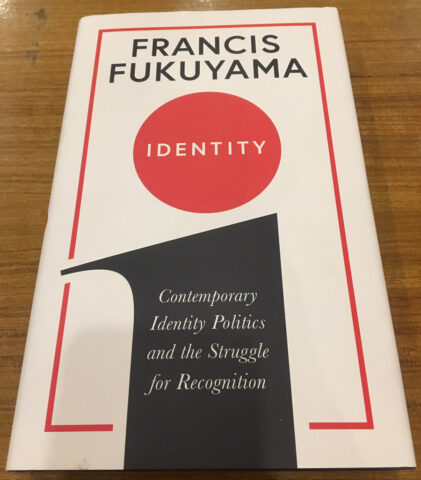
Identity: Contemporary Identity Politics and the Struggle for Recognition by Francis Fukuyama
- Author : Francis Fukuyama
- Publisher : Profile Books; Main edition (4 Oct. 2018)
- Language : English
- Hardcover : 240 pages
- ISBN-10 : 9781781259801
- ISBN-13 : 978-1781259801
Dualta Roughneen