An Irish mum who is a full-time family carer has added to calls for the Carer’s Allowance means test to be scrapped by the Government.
Niamh Ryan, a mother to twin boys turning 14 in June, is full-time carer for one of her sons, Liam, who has cerebral palsy. In March, her Carer’s Allowance was reduced by 90 euro per week after an audit was carried out assessing her husband’s income which had risen slightly due to Public Servants’ pay increases.
Their son Liam, who uses a wheelchair and is tube fed, has severe spastic quadriplegic cerebral palsy. He also has epilepsy, global developmental delay, scoliosis, hip dysplasia, cortical visual impairment and chronic lung conditions. The teenager from Portlaoise therefore requires full assistance for all his needs and round-the-clock personal care from his mum, Niamh.
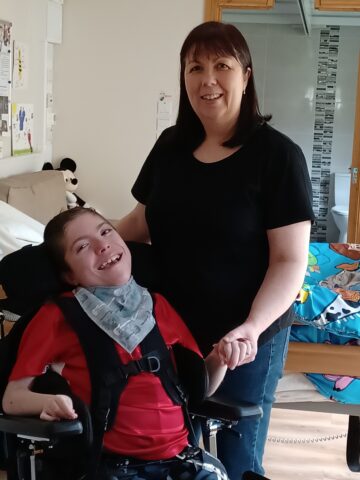
Niamh, who is waiting in hope of reform to the current system after addressing the Oireachtas Social Protection Committee earlier this month along with representatives from Family Carers Ireland, has told Gript that the problem lies in the system.
Speaking after her recent address to the Dáil, during which she told the Committee, ‘I don’t feel valued’, she said that means testing is ‘wrong’ considering the demands placed on family carers.
“I always knew this wasn’t going to be a quick fix for me. It’s the system [that is the problem]. The means test shouldn’t be there in the first place. We’re all doing this job which is 24 hours a day, seven days a week.
“You don’t get holidays; there is no respite. So the fact that it is means tested at all is just wrong.”
With regards to the means test and her allowance being reduced, Niamh added:
“What really annoyed me and deeply upset me – and I know another few parents and the same thing has happened to them over the last couple of years – it just completely devalues what you do. Any other couple who are working, one salary is not means tested against the other, and rightly so. But in family carers’ cases, that’s exactly what they’re doing which is so unfair.
“Family carers are only looking for what is needed; nobody wants to have to do this, but what we are looking for is an absolute necessity.”
The mother of two highlights the realities of caring for someone like her son Liam, who has such complex medical needs. Niamh said the means test does not take into account the financial cost of caring for such needs.
“If there does have to be a means test, it should at least be fair. All [the Government] does is look at the income or the salary that’s coming into the house.”
“They don’t look at the cost of caring at all – and when you’re looking after somebody with complex medical needs, there’s substantial additional costs involved.
“So if you’re a carer looking after someone like our son who has so many medical needs, you’re at a distinct disadvantage to someone who’s not looking after someone like that because we’re all under the same system of means testing. If you are caring for someone with complex needs, then the cost of caring is so much more.”
‘You have no choice’
Adding that carers have ‘no hope of future employment’, Niamh says the Government must recognise that full-time family carers have no choice when it comes to earning money.
“The vast majority of us have had to give up our paid employment to look after our children. When it’s a lifelong condition, you have no hope of future employment, really. You have absolutely no choice not to work.
“The problem is that you have no choice. I have no choice; I cannot get a job, although you’re allowed to work 18.5 hours outside of a caring role, I can’t do that [owing to Liam’s appointments and level of care]”.
“Liam has a life-limiting condition, and I dread the day I don’t have to care for him, but it needs to be recognised that your choices are taken away from you, and the way the system is set up is just downright insulting.”
She added: “The whole system and the attitude towards family carers needs to change.”
Liam, who has enjoyed returning to school after isolating during lockdowns because of his level of vulnerability, is on 28 doses of 18 different medications and 4 nebulisers every day at minimum.
“You’re mostly spending your time chasing prescriptions and doing the ‘admin’ part of caring. There’s a lot of things that have to be done, ordering medicines and collecting medicines; there’s a lot of stuff that has to be done when Liam is at school,” she added.
Niamh also points to costs for parents including the cost of a child being in a hospital away from home.
“Liam has spent weeks on end in Temple Street, and that’s very costly. It’s a difficult situation when children are in hospital.”
The rising cost of diesel is another expense that has to be taken into account for parents travelling to appointments, along with other costs including home adaptations and wheelchair accessible travel.
While the Ryans’ family home was adapted five years ago with the help of a local authority grant, Niamh says “it’s even tougher for families now” because of the rocketing cost of building.
“It’s all those extra costs that are really hard on families, and that’s on top of the fact that if your child is in a wheelchair, like Liam is, you have no option but to purchase a wheelchair accessible van, which is huge money. There are all these extra costs involved.”
More support would prevent hospital admissions
Niamh believes that providing the necessary medical equipment for families would be another step in the right direction for the Government, and could save money by preventing hospital admissions. At home, Liam has a hospital bed with an air mattress, suction and oxygen machines, nebuliser machines and monitors, which are all left charging and ready to use. The equipment was moved into the home after Liam was critically ill on life support in Temple Street for several weeks aged five. Having the right equipment at home has meant he has been able to avoid being hospitalised to the same extent.
“If the Government would just look at the bigger picture, they probably would end up saving money in the long-run,” Niamh said, adding: “I know that since we adapted our house with Liam and we got all the equipment that he needs, we were not in and out of hospital as much because of this.
“When families are given the support and the necessary equipment, that makes such a difference to everybody’s quality of life, and you’re also cutting down hospital admissions which is saving the state huge amounts of money and freeing up beds for other people, so just giving that support to families can be beneficial to everybody.”
She says enacting certain changes should therefore make sense to the Government from a financial point of view.
Niamh also says the Allowance itself needs to be increased in order to adequately provide for families caring for a loved one. She highlights the fact that the Government deemed 350 euro a week a necessary amount to give those who lost their jobs due to Covid, but yet “somehow, this amount is not deemed necessary for family carers.”
“I think the Carer’s Allowance itself needs to be looked at, and the means test also needs to be looked at.”