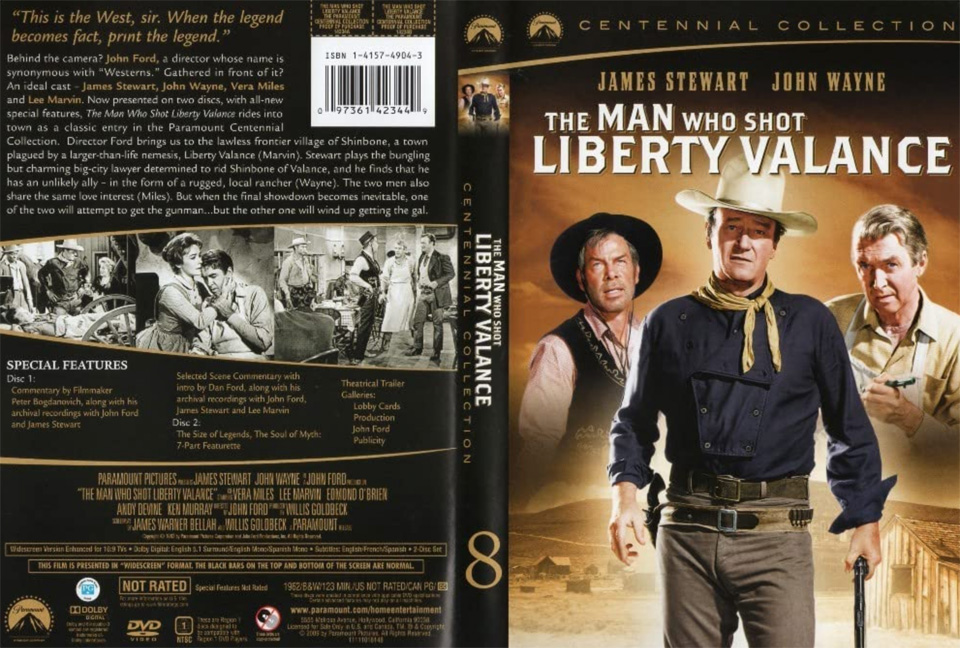
The frontier town that Ranse Stoddard (Jimmy Stewart), a young lawyer hoping to establish a legal practice, arrives in, is ruled by an entirely different code than what exists in the law schools back east where Stoddard came from. Shinbone is on the cusp of change and the people are ready for this new order of law by the book, but as Stoddard arrives it is still ruled by men of force who live by a different code.
We find that there is a thirst for this transformation that Stoddard wishes to implement. The frontier has been broken and now it must be tamed. However, the frontiersmen who broke the wilderness are reluctant to give up their position and are determined to hold onto their world using the old methods of force.
The very opening scene is a shock to the eye and the presumptions of law carried in the heart of Stoddard. His coach is accosted by bandits, and when Stoddard protests that the law will find them and serve justice, the lead bandit administers a humiliating lesson that the law of the frontier is decided by the strongest arm and the fastest gun.
Stoddard is left for dead and rescued and brought into Shinbone by a merciful stranger, a rancher named Tom Doniphon, where he soon learns that his assailant is not a shadowy wraith on the outskirts of town, but a tyrant named Liberty Valance who flagrantly rules the entire community by fear. Doniphon (played by John Wayne), the patroller of the edges, also proves a seminal character in the morality play that unfolds.
Stoddard gets a position in the town eatery and starts a schoolroom where he teaches the townsfolk reading and civics. The owner of the eatery, Hallie, falls under the spell of the learned Stoddard and we see that Doniphon, who has loved her earnestly, loses hope of winning her heart. This leaves Doniphon in a dilemma. Should he help Stoddard, or should he let him be chewed up by the likes of Valance?
Although formed by the same rugged reality, Doniphon is a different creature to Valance. He steps in to save Stoddard from Valance on three different occasions. On each occasion, the errudite Stoddard is way out of his depths in the face of the potent menace of Valance –who by the way, is a brilliantly played sociopathic bad guy.
The first occasion has Valance come into the eatery where Stoddard is working. With Valances reputation a frigid quietness descends on the restaurant. Stoddard walks into this from the kitchen and a panic is visible on his face when he sees Valance taunting him with his presence. Stoddard tries to ignore Valance, but Valance, with a sneer on his face, sends him crashing to the floor in humiliation. He is about to repeat the lesson from the start of the film when Doniphon steps in. Things were scary at this point, but the tension introduced of this moment is hair raising.
The film has many artfully drawn scenes and the perfect archetypal characters to fill out the drama in them. When Stoddard is nominated to represent the territory in the US Senate, at the territory convention his opponent, a cattleman named Langhorne, is nominated by a wonderful caricature of dishonest political chicanery.
A perfectly groomed dandy in an expensive double breasted coat he protests “I came here with a perfectly prepared speech, but this is no time for prepared speeches”.
His ad hominem attack on Stoddard, who he decries as a bloodstained vigilante, is a thing of pure sophist excellence. The final shot of him sees a self satisfied smirk flicker on his face as he finishes his defamatory demolition of Stoddard.
This is a film of fascinating characters and a nuanced examination of how narratives, codes, and myth, shift and conflict; and are used or discarded in accordance with the need of their times. Stewart is an avatar of a new order that the frontier is thirsting for. Liberty Valance and Tom Doniphon are relics of a frontier mentality; hard-sinewed men of resolute will who can temper the wilderness.
In Shinbone this brutish frontier vision has out-served its purpose and the vision of order and law represented by Stoddard would inevitably take its place.
These are the conflicting visions at place. However for Stoddard’s vision to achieve primacy he must enrol the support of Tom Doniphon, who better than anyone else understands the force of Liberty Valance. Although Stoddard never requests the support of Doniphon, it is plain to all that Stoddard can’t supplant Valance, who lives by an entirely different code to Stoddard. The code of Valance has supremacy and can only be subdued by force. Doniphon is needed to do the dirty work, but he’s a cause of embarrassment to the citizens of the new Shinbone who have upward ambitions and a thirst for a regulated intellectual life.
So although Stoddard and the people of Shinbone desperately need Doniphon to deal with Valance, they have no further use for him once he has served this purpose. Like Hector of the Illiad, Doniphon is tragically misunderstood, but an essential character.
The film introduces Stoddard 25 years after these events as a seasoned senator returning to Shinbone. Stoddard’s story is triumphal, and we learn through flashbacks that its genesis arose in a confrontation with the darkly sadistic Valance.
Paradoxically, Stoddard ushered in the new code by participating in the ultimate ritual of the old code, a duel.
Valance set the agenda for this and yet somehow it was he who fell after Stoddard’s shot rang out. Stoddard, it seemed, had ascended to the pinnacle of the old code so he could replace it with the new. A legend had been born with that showdown and it would elevate Stoddard to the US senate.
However, in a later twist in the tale, we learn that that legend was fake. We learn that Stoddard and Doniphon had broken the code of the duel. We learn that Stoddard, had broken a different code of honour in whisking away Doniphon’s sweetheart. We learn that Valance, bizarrely enough, was the only honourable actor according to the code of the west in that showdown.
This is a fascinating story about myth and truth.
With this masterpiece director John Ford, created his most thoughtful and nuanced examination of the differences between myth and truth. It’s also one of the great American westerns, with Stewart and John Wayne finding new subtleties in characters they’ve often played.
The great theme of a confrontation between progress and lawlessness; between the law of the gun and the law of the book, between order and chaos; is played out in a complex set of characters.
The most incisive comment on this comes from the editor of the Shinbone Star after hearing the full story of the shooting of Liberty Valance. This sets up a deeper implicit insight.
In the tale of Valance, Doniphon, and Stoddard, the values of premodernism reluctantly give way to those of modernism; but this question foreshadows another question of progress, the Hegelian conflict of modernism and postmodernism –the spiral of history.
The implication of this is that the age of reason inevitably gives way to the age of unmoored rationality. We see the first transformation in the rise of Stoddard, but the second stage is only hinted at by the editor of The Shinbone Star after hearing Stoddard’s account of the duel.
Modernism can only flourish after premodernism is dispensed with, but the birth of modernism (and reason) is also the conception of postmodernist rationalism . Stoddard could not have thrived without the tragic Hector-like figure of Doniphon. Even though the rough Doniphon was an embarrassment to the forward striving people of Shinbone, he was a necessity to deal with the unstoppable atavism of Valance.
Having completed his necessary usefulness, Doniphon is discarded as a relic of this redundant worldview. This in spite of the fact that his intervention was absolutely necessary for the birth of this new order of law.
This all has the ring of mythic epic, worthy of Euripides, to it. As Nietzsche deduced in the birth of tragedy, the age of Gods and heroes is transformed to the age of man and reason, and reason is eventually replaced by rationalism. -The premodern is a prerequisite of the modern and the arrival of the modern is the birth of the postmodern. In its birth modernism, represented as “reason”, conceives its own replacement “rationality,” and so rationality is the regicidal son of reason.
The editor of The Shinbone Star encapsulates this all with one insightful aphorism “when the legend becomes fact, print the legend”.